
@clankie/discord-user-session
Clankie's personal-lab Discord body: a normal-user session that participates in text and voice as the same character the official bot is (ADR 0048).
Discord forbids automating normal user accounts. This plane is off by default and reachable only after the owner records a durable acceptance of the account and ToS risk. That risk is the account owner's.
/discordActive body chooses which process is the mouth. The launcher starts only that one. This process talks, watches, and Go Lives only when it is active.
Why a second process
ADR 0024 requires that bot
and user credentials never share a gateway. A separate process makes that
structural instead of conventional, and keeps a normal-user token out of the
same process image as the official bot token. Everything above the transport —
ingress shaping, captain lane addressing, consent, capture, memory, receipts —
is @clankie/discord-presence-core, shared with the bot bridge.
The credential guide distinguishes the bare normal- user token from the official bot token and Clankie's four local bridge bearers.
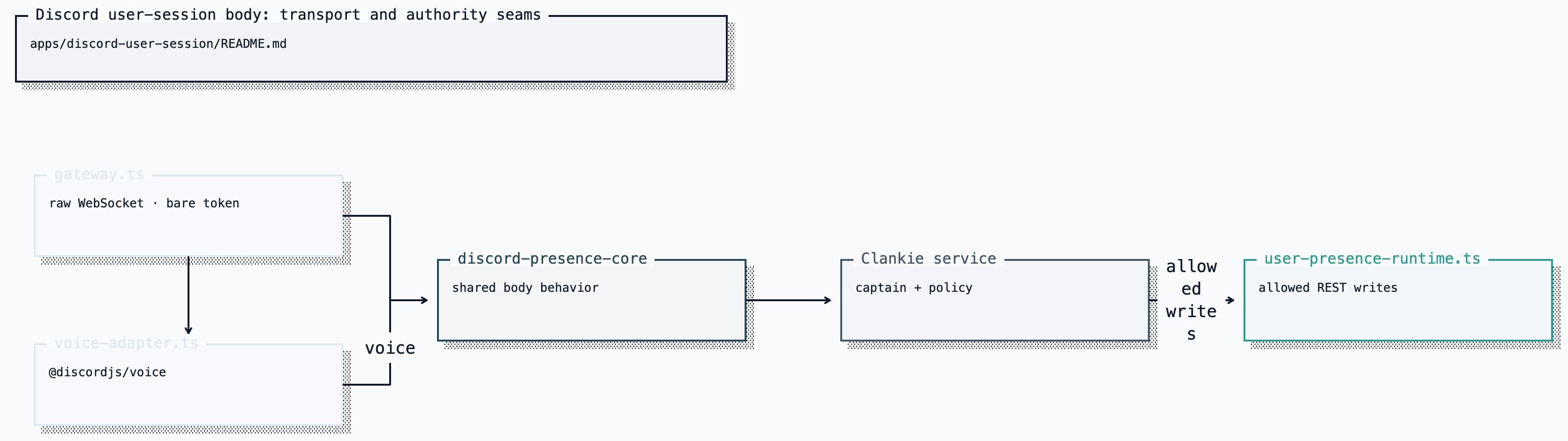
Editable Turbopuffer tldraw source
This image is the historical credential-isolation view. The canonical current media diagram is ADR 0128.
Admission, all fail-closed
readiness.ts checks these in order, cheapest first. The brokered token is
resolved last, so a run that will be refused never materialises a user
credential in process memory.
DISCORD_ACTIVE_BODY=user_session; direct startup cannot bypass launcher ownership.DISCORD_USER_SESSION_ENABLED=trueplus non-empty guild/channel allowlists.- A durable, non-revoked owner opt-in bound to the character and recorded scope. Configuration may narrow that scope, never widen it.
- A brokered
discord_user_sessioncredential.DISCORD_USER_TOKENin the environment is a startup error.
Run pnpm --filter @clankie/discord-user-session readiness to diagnose a
refusal and verify the Vox executable without connecting to Discord.
That preflight does not prove process_ready, a role transport, or DAVE; those
facts exist only after the body and relevant Discord role run.
Recording the opt-in
Use the TUI's direct /discord flow to store the user token, set allowlists,
record the acknowledgement, and select the active body. It calls the
operator-authenticated service route without exposing the operator bearer in a
shell. Revocation stops the next action rather than waiting for grant expiry.
Configuration
| Variable | Purpose |
|---|---|
DISCORD_USER_SESSION_ENABLED | Master switch; default off |
DISCORD_USER_SESSION_GUILD_IDS | Allowlist, comma-separated, required |
DISCORD_USER_SESSION_CHANNEL_IDS | Allowlist, comma-separated, required |
DISCORD_USER_SESSION_DM_POLICY | deny | owner_only (default) | allowlist |
DISCORD_USER_SESSION_DM_USER_IDS | DM allowlist when dmPolicy=allowlist |
DISCORD_USER_SESSION_VOICE_ENABLED | Voice participation; default off |
DISCORD_USER_SESSION_VOICE_CHANNEL_IDS | Voice channel allowlist |
DISCORD_USER_SESSION_RECEIPT_PATH | Absolute path outside the workspace |
CLANKIE_DISCORD_USER_PRESENCE_RUNTIME_MODULE | Service load target for src/presence-runtime-module.ts |
At startup the plane fills unset DISCORD_* names from the operator settings
file (@clankie/settings, configured with /discord in the TUI), including
the lab-body allowlists. Configuration may narrow the recorded opt-in, never
widen it.
Voice provider settings are shared with the bot body and configured through
/voice. The active body uses the selected brokered openai or xai API key,
model, voice, and xAI reasoning effort; both bodies therefore sound and wake
the same way after an active-body switch.
Whenever this active body has a voice session, it hosts the fixed
ws://127.0.0.1:4323/play loopback endpoint from @clankie/play-voice for
Clankie's own play loop. Narration, admitted room text, consented transcripts,
room state, and shutdown follow the same paths as the bot body. The bearer is
not issued to GBA MCP or external harnesses, so this endpoint cannot turn the
lab body into their mouth or room-input feed.
Text-only messages in the active voice channel's attached chat enter the same
VoiceFloor as speech. The realtime room persona may answer aloud, hand work
to the captain, or stay silent; the user-session bridge does not also launch a
text reply for that delivery
(ADR 0124).
Capability differences from the bot plane
| Capability | Bot | User session | Why |
|---|---|---|---|
| Text, reactions, threads | ✅ | ✅ | Shared catalogue, one lane, one memory |
| Group voice (DAVE, realtime) | ✅ | ✅ | One Vox child via the user-session gateway |
| Slash commands | ✅ | ❌ | A user account cannot register them |
| Ambient context messages | ✅ | ❌ | Would require reading channels wholesale |
| Embedded activities | ✅ | ❌ | Owned by the bot application (ADR 0047) |
| Watch a screen share | ❌ | ✅ | Only when this body is active; OP20 + Vox stills |
| Go Live | ❌ | ✅ | Only when this body is active; OP18/OP22 + Vox |
Watching screen shares
The official bot cannot receive Go Live video. This process can. When someone
in an allowlisted channel hits Share Screen, the lab body joins the channel,
sends OP20 STREAM_WATCH, and Vox decodes one JPEG per second. The service
keeps a four-frame rolling window, and the captain looks across those
chronological samples with observe_share.
One app-lifetime Vox child owns ordinary voice, TTS, audible music, screen watch, and Go Live. A membership coordinator keeps all active roles in one guild/channel: voice is unmuted, stream-only membership is muted/deafened, and the gateway leaves only after the final role releases its lease.
This is distinct from the public Activity and from publishing Clankie's own Go Live stream; the Discord media guide diagrams all three paths.
pnpm --filter @clankie/vox build
Enable the body in /discord → Lab user body (token, allowlists that include
the voice channel, ToS opt-in), then clankie restart. After a real share:
pnpm --filter @clankie/discord-user-session watch-live-proof
# or wait up to two minutes while someone shares:
pnpm --filter @clankie/discord-user-session watch-live-proof -- --wait=120
The gate requires a fresh, correlated ready receipt identifying Vox as the
mediaOwner, exact Vox IPC protocol readiness, and gateway readiness. A matching
watch_connected must prove both the stream-watch transport and positive DAVE
readiness before one decoded still of that same user. Stale receipts from an
older process or the pre-Vox-proof format do not qualify. Deterministic tests
cannot mint those receipts. The CLI reads
${XDG_STATE_HOME:-~/.local/state}/clankie/discord-user-session-receipts.jsonl
unless DISCORD_USER_SESSION_RECEIPT_PATH overrides it.
Go Live publish
go_live_start is refused on the official bot. On this process it:
- Joins the target voice channel as the active lab body
- Sends OP18
STREAM_CREATE, then OP22 unpause - Hands stream-server credentials to Vox through
@clankie/vox-client - Plays an optional
sourceUrl, or pumps the live activity PNG snapshot (GET 127.0.0.1:4322/snapshot) when he is already on the activity plane
discord.stream.publish_started is content-free and is recorded only after
Discord accepts OP18 and OP22, the stream-publish transport is ready, DAVE is
positive, and Vox reports the first accepted H264 media for that publish. Verify
that ordered evidence against the current process's fresh ready receipt with:
pnpm --filter @clankie/discord-user-session publish-live-proof
# or wait up to two minutes for first media:
pnpm --filter @clankie/discord-user-session publish-live-proof -- --wait=120
Songs go through the model, not a chat parser. Text uses the captain's
youtube_search / music_play tools (they POST to this process on
/music/*); voice uses the same tool names on the realtime session. Both use
DiscordVoiceSession.music, so music is audible through the ordinary Vox voice
transport and native end-of-track events advance its queue. Explicit Go Live
start/stop commands remain independent of music playback.
Voice presence is agentic too (ADR 0062).
The captain's argument-free voice_join / voice_leave tools POST to this
process on /voice/*. A Discord turn supplies the authenticated owner and
guild; an operator-console turn supplies neither, and the gateway follows that
same owner into their current allowlisted channel (not_in_voice / ambiguous
when that is not unique). Only DISCORD_OWNER_USER_ID may move the lab body,
and the recorded guild/channel allowlists still bind the result. A new join
auto-opts that authenticated owner into live speaker-attributed transcription,
which the captain discloses in his reply.
Reactions and thread actions are grounded in the current ingress message. The
same captain discord_watch_start / discord_watch_stop tools map to Go Live
on this body, but only after the gateway freshly resolves the owner in the
active allowlisted voice channel.
The local lab body uses @clankie/vox through the separately licensed
@clankie/vox-client process boundary. Without a running lab process,
go_live_start is unavailable.
GET /health is readiness, not a process-only liveness claim. It returns 503
before gateway READY, while reconnecting, when the exact Vox IPC handshake is
not ready, and permanently after a terminal gateway or Vox failure until the
supervisor starts a new process.
Primary voice leave releases only the voice role. It must not stop an active
watch or publish role; the gateway leaves the channel only after the last role
lease ends. A discord.voice.left receipt qualifies only after the account
gateway confirms detachment and records gatewayConfirmed: true with
mediaOwner: vox. Full body shutdown disconnects streams, leaves voice, removes
listeners, closes the one Vox child, and then closes the account gateway. A live
deployment must show that ordering and no duplicate media owner.
Account risk. Automating a normal Discord account violates Discord's terms and can get the account permanently terminated. That risk is the owner's to accept, which is why the plane stays behind the recorded opt-in.