
ADR 0048: One character, two Discord bodies
Status: accepted (James, 2026-07-25). Screen-share watch and Go Live publish, originally deferred here, shipped through ADR 0098 (user-session shares) and ADR 0100. Current-status addendum (2026-08-19): ADR 0128 governs the one child and role-specific media lifecycle for either media-enabled active body; text-only official-bot mode spawns no child. This ADR's one-active-body, credential isolation, opt-in, and allowlist decisions remain in force. References to doctrine and deployment profiles describe the retired implementation at ratification.
Context
ADR 0024 reserved user_session as an
isolated transport. A bot cannot Go Live or participate as a normal member in a
friend's server, while character, lane continuity, consent, and receipts are
not properties of a Discord credential.
Discord forbids automating normal user accounts. This body is therefore an explicit personal-lab capability, never the supported default.
Decision
Runtime binding, not character fork
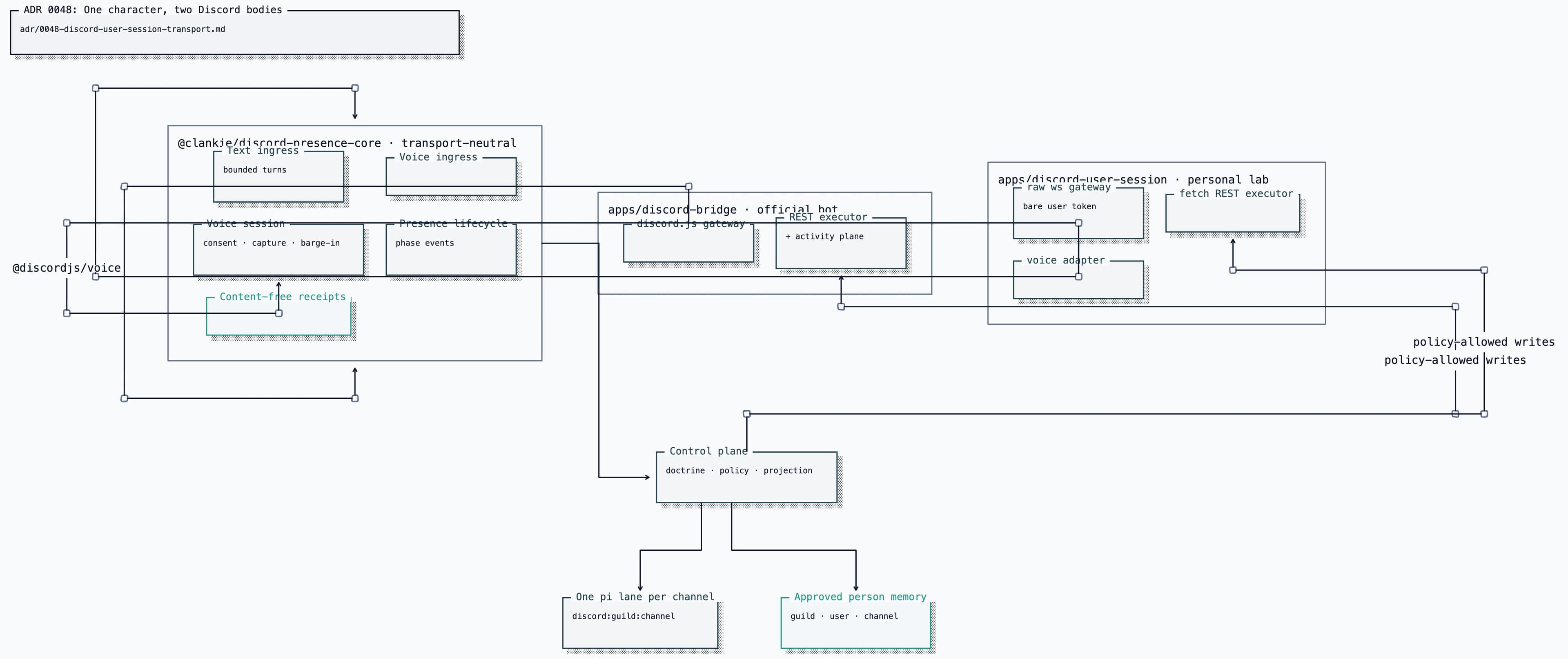
DiscordTransportKind names which credential opened the gateway. Action
contracts remain transport-neutral and declare which bodies can perform them.
Exactly one configured body is active: the launcher starts either the official
bot or apps/discord-user-session, and voice/media attach to that one mouth.
Editable Turbopuffer tldraw source
| Action family | Bot | User session |
|---|---|---|
| text, reactions, threads, voice, attachments | yes | yes |
screen-share watch and go_live_* | no | yes |
embedded activity_* | yes | no |
Lane identity derives from the room (discord:<guild|dm>:<channel>), never the
transport. Switching bodies therefore continues one character and one
conversation scope.
Isolation and admission
The user body is a separate process and never imports or receives the bot credential. It reaches the normal-user token only after three fail-closed gates:
- explicit enablement plus non-empty allowlists;
- a durable, revocable owner opt-in whose recorded scope cannot be widened by configuration; and
- a brokered
discord_user_sessioncredential, resolved last.
At ratification a fourth doctrine/profile gate also existed and the opt-in was bound to its hash. That policy subsystem has since been removed; this is historical rationale, not a current setup requirement.
Transport identity is bound to the authenticated local bearer, never accepted from the request body. Each process loads only its own privileged executor.
Alternatives considered
- A mode flag in the bot process was rejected because it would place both credentials in one process image.
- Duplicate the participation stack was rejected because consent, capture, and lane addressing would drift.
- Self-declared transport in action payloads was rejected because it would be a privilege-escalation path.
Consequences
- One active body owns the mouth and media session.
- The user body has no slash commands and cannot request broad channel history.
- Watch and publish are implemented, but account and ToS risk remains the owner's explicit choice.
- Current setup, configuration, and live proof belong in the user-session operating guide.