
Backend Configuration
This doc explains where consumer configuration lives for swarm-mcp, workspace backends, spawners, and runtime integrations.
The short version: agents should keep using swarm tools (dispatch, prompt_peer, peek_peer, tasks, messages). Backend selection belongs to launcher/config, not to normal agent reasoning.
Mental Model
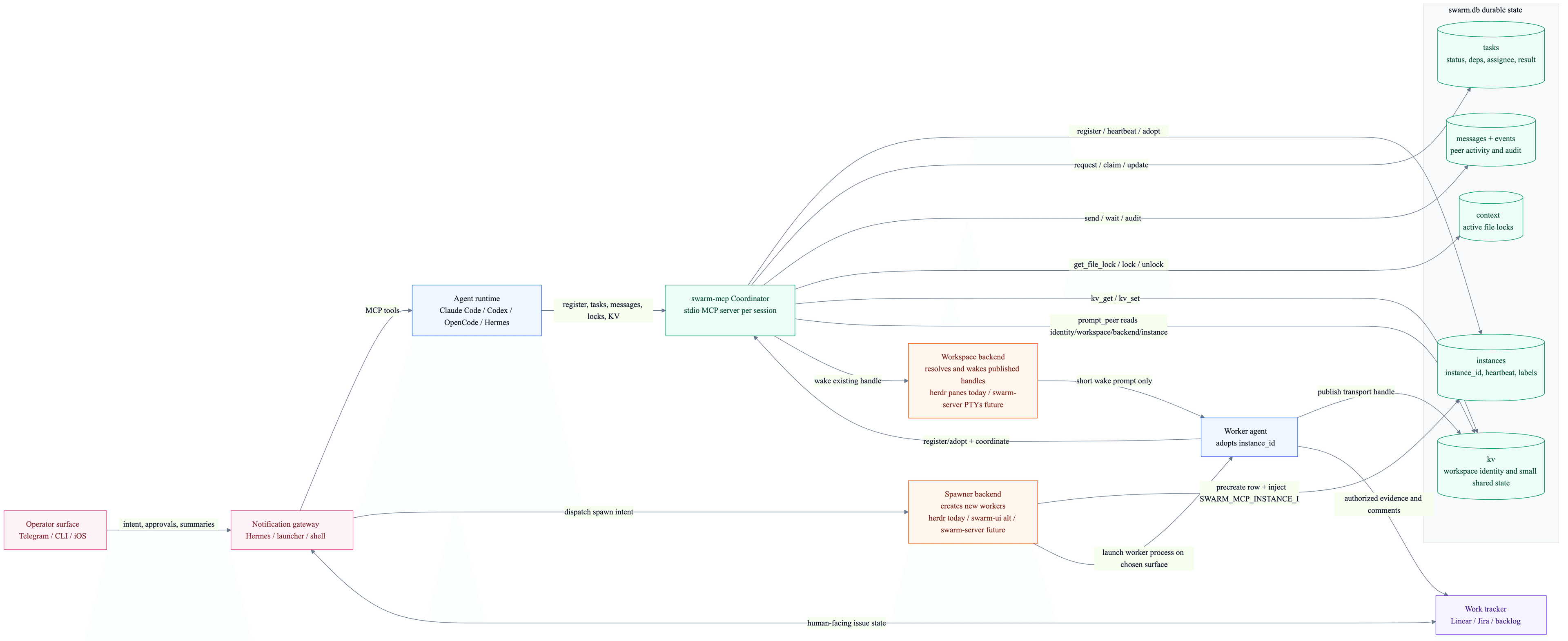
Source: docs/diagrams/backend-configuration.mmd. Render with bun run diagrams.
Durable coordination uses swarm instance_id and state in swarm.db. Workspace handles such as herdr pane_id or a future swarm-server pty_id are transport-local and live behind workspace identity rows.
Spawner and workspace backends are capability boundaries, not necessarily different products. The spawner creates a new worker; the workspace backend resolves or wakes an already-published handle for an existing worker. Herdr currently implements both capabilities, while swarm-ui is only a spawner backend.
Work tracker selection is separate from workspace/backend selection. Runtime hooks publish configured same-identity tracker metadata to swarm KV at config/work_tracker/<identity> when present, and bootstrap returns the matching row. Agents should then verify the matching MCP is available; they should not choose a tracker from the loaded MCP list alone.
Configuration Layers
| Layer | Owns | Examples |
|---|---|---|
| MCP host config | Mounts the swarm MCP server in an agent host. | .mcp.json, ~/.codex/config.toml, ~/.claude.json, opencode config |
| Runtime integration config | Hooks/plugin behavior for a host. | Hermes plugin, Claude Code hooks, Codex plugin hooks |
| Launcher/profile config | Account and tool visibility boundary. | swarm_define_profile aliases from env/launchers.zsh.example |
| Work tracker config | Human-facing tracker selection by repo/scope and identity. | ~/.config/swarm-mcp/<identity>.env, SWARM_<runtime>_WORK_TRACKER, SWARM_WORK_TRACKER, .swarm-work-tracker, Hermes swarm.work_tracker |
| Coordinator config | Shared DB and swarm scope defaults. | SWARM_DB_PATH, SWARM_MCP_SCOPE, SWARM_MCP_FILE_ROOT |
| Spawner config | Which backend creates new workers. | SWARM_SPAWNER, SWARM_DISPATCH_SPAWNER, dispatch(... spawner) |
| Workspace backend config | Which backend resolves/wakes existing published workspace handles. | Current default: herdr; future: configurable backend default |
Current Supported Backends
| Capability | Current support | Selection |
|---|---|---|
| Workspace wake/handle backend | herdr only | Published KV row identity/workspace/herdr/<instance_id> |
| Default spawner backend | herdr | Default when no spawner is specified |
| Alternate spawner backend | swarm-ui | SWARM_SPAWNER=swarm-ui, SWARM_DISPATCH_SPAWNER=swarm-ui, or dispatch(... spawner: "swarm-ui") |
swarm-server backend | Not active as a swarm-mcp backend yet | Requires new backend implementations before config can select it |
swarm-server exists today as the Rust desktop/mobile daemon. It is documented in swarm-server.md, but it is not yet registered as a swarm-mcp workspace backend or spawner backend.
The same adapter family may provide both capabilities. Keeping the contracts separate lets a gateway use one backend to request creation, then let workers publish whatever workspace handle they actually receive for later wakeups.
Current Herdr Setup
Herdr-launched workers publish workspace identity when these env vars are present:
| Env var | Purpose |
|---|---|
HERDR_PANE_ID / HERDR_PANE | Transport-local pane handle to publish. |
HERDR_SOCKET_PATH | Herdr socket used by wake/status calls and direct pane.report_agent status reporting. |
HERDR_WORKSPACE_ID | Optional workspace metadata. |
SWARM_HERDR_BIN | Optional non-default herdr binary path. |
For local development, prefer identity-scoped shared herdr sockets:
# work
export HERDR_SOCKET_PATH=/Users/james.volpe/.config/herdr/sessions/work/herdr.sock

# personal
export HERDR_SOCKET_PATH=/Users/james.volpe/.config/herdr/sessions/personal/herdr.sock
Launch both the visible desktop herdr server and the matching-identity gateway
with the same value. The personal path is visible to sandboxed personal gateways
that can access /Users/james.volpe/volpestyle, while keeping it separate from
work identity state. Work identities use their own host-visible socket under
/Users/james.volpe/.config/herdr/sessions/work.
The published KV row is:
identity/workspace/herdr/<instance_id>
with a value like:
{
  "schema_version": 1,
  "backend": "herdr",
  "handle_kind": "pane",
  "handle": "pane-id",
  "pane_id": "pane-id",
  "socket_path": "/path/to/herdr.sock",
  "workspace_id": "workspace-id"
}
Runtime integrations also write the legacy compatibility key identity/herdr/<instance_id> for current consumers. New integrations should publish the generic identity/workspace/<backend>/<instance_id> shape.
When both HERDR_SOCKET_PATH and HERDR_PANE_ID/HERDR_PANE are present,
runtime hooks also report pane agent status directly to herdr with
pane.report_agent after successful swarm registration and call
pane.release_agent during cleanup. Missing env vars, socket errors, or herdr
RPC errors are fail-open: the workspace identity KV still publishes when
possible, and herdr falls back to its normal process/output heuristics.
Current Dispatch/Spawner Setup
Gateway sessions should call the MCP dispatch tool. Operator shells and hooks can use swarm-mcp dispatch.
Spawner selection order:
- Explicit
dispatch(... spawner: "...")or CLI--spawner. SWARM_SPAWNER.SWARM_DISPATCH_SPAWNER.- Default:
herdr.
Herdr dispatch uses:
| Env var | Purpose |
|---|---|
HERDR_PANE_ID / HERDR_PANE / SWARM_HERDR_PARENT_PANE | Parent pane to split from. |
SWARM_HERDR_SPLIT_DIRECTION | Split direction; default right. |
SWARM_WORKER_HARNESS / SWARM_DISPATCH_HARNESS | Worker launcher command. |
SWARM_HERDR_BIN | Optional non-default herdr binary path. |
Dispatch chooses the worker launcher from the requester identity, not from the
current shell alone. It reads SWARM_HARNESS_CLAUDE / _CODEX / _OPENCODE /
_HERMES from the requester's profile env (~/.config/swarm-mcp/<profile>.env)
to resolve the launcher alias for each canonical harness. Generic harness
requests (claude, codex, opencode, hermes) and cross-profile aliases
both normalize through this mapping. The herdr spawner pre-creates a swarm
instance lease with the requester identity: token, injects
SWARM_MCP_INSTANCE_ID and SWARM_MCP_LABEL, and waits for the worker to
adopt/register. Dispatch releases the spawn mutex only after the worker is
registered and bound to the task.
Dispatch itself still returns immediately after task handoff/spawn unless the
caller opts into task completion monitoring. Use MCP
completion_wait_seconds or CLI --wait-for-completion <seconds> to wait for
the task state to reach done, failed, or cancelled; the response keeps
the normal dispatch status and adds a completion object.
Switching To Swarm Server Later
Switching to swarm-server should be a config flip only after the backend support exists.
Required implementation first:
- Add a
swarm-serverWorkspaceBackendfor resolving and waking PTY/session handles. - Add a
swarm-serverSpawnerBackendfor creating worker PTYs through the daemon. - Register both backends in the MCP server/CLI startup path.
- Update launchers/hooks so swarm-server-launched workers publish
identity/workspace/swarm-server/<instance_id>.
Expected future consumer config shape:
SWARM_SPAWNER=swarm-server
SWARM_WORKSPACE_BACKEND=swarm-server
SWARM_SERVER_URL=http://127.0.0.1:5444
SWARM_WORKSPACE_BACKEND is the intended future default selector for handle resolution, but it is not implemented today. Today, workspace wake resolution works from the backend name embedded in the published identity row, and only herdr is registered.
Future swarm-server identity rows should look like:
identity/workspace/swarm-server/<instance_id>
{
  "schema_version": 1,
  "backend": "swarm-server",
  "handle_kind": "pty",
  "handle": "pty-id",
  "pty_id": "pty-id",
  "server_url": "http://127.0.0.1:5444"
}
What Agents Should Do
Agents should not decide whether the transport is herdr, swarm-ui, or swarm-server.
- Use
dispatchfor gateway spawn/routing. - Use
send_message,request_task,prompt_peer, andpeek_peerfor coordination. - Target swarm
instance_id, never raw pane/PTY IDs. - Let workspace identity and backend adapters handle transport-specific wakeups.
If a backend is not configured or not available, agents should report that and ask the operator rather than inventing another spawn path.