
ADR 0095: Discord system actors
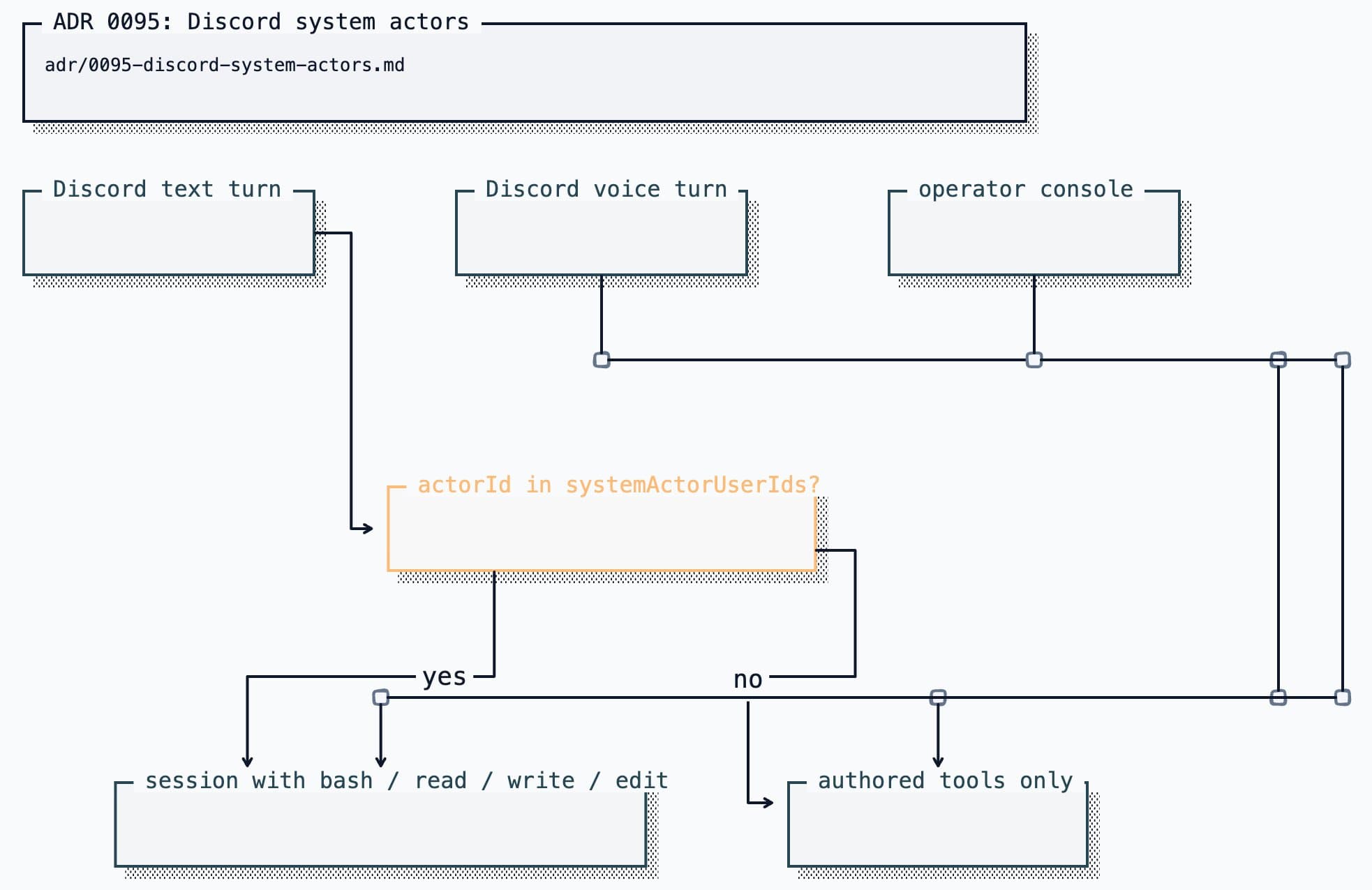
Status: accepted (James, 2026-08-15). Defines the Discord authority split with ADR 0050 and the operator-only coding tools in the pi captain. Amended by ADR 0105: the allowlist now reaches voice as well, on the one-shot session boundary this record named as the missing precondition. The "voice never gets the tools" rule below is historical. Further amended by ADR 0133: individual grants stay one-shot in shared rooms, while trusted private DMs and guild rooms may carry a durable tool bank.
Context
The captain leads through the herdr CLI over bash. Those coding tools (read / bash / edit / write) are pi built-ins and run unsandboxed as the service user. Only the operator console had them. A Discord lane is fed by untrusted channel text, so it kept the authored tool bank — pictures, play, the other rooms — and nothing that touches the filesystem. The framing labels that text as untrusted, but a tools list is a boundary and a prompt is not.
That is why a Discord "can you see what we're doing in herdr?" is answered
honestly with no. The herdr socket is reachable from the service
(herdr pane list works without HERDR_ENV=1); the tools are simply not
on the session.
The owner still wants to drive herdr from Discord — but only when they
ask. Ambient slash-command authority and the DM-policy owner are the wrong
bindings: ADR 0050 already refused to reuse ownerUserId for voice so two
unrelated policies would not move together, and ambientUserIds is the
tier that can /clankie join. Handing that tier a shell would collapse
"can summon him" into "can run commands on this machine."
Decision
A new settings list, discord.systemActorUserIds, names the Discord users
whose text turns get the operator's machine tools.
- Empty means nobody. Discord stays social. Deny by default.
- The operator console is always privileged and does not consult the list.
- Voice never gets the tools. That session is durable and shared across speakers; builtins on it would let anyone in the call drive the machine.
- Distinct from
ownerUserId(DM policy) andambientUserIds(slash commands). Those policies can move without handing out a shell. - Reloaded per turn from the settings file (environment still wins, same as every other Discord allowlist). Removing someone takes effect on the next message, not the next process restart.
- Mail stays operator-console only. Dumping an inbox into Discord is a disclosure, not a machine-control grant.
The herdr skill's HERDR_ENV=1 stop is for agents sitting in a pane. The
captain is a service. His instructions say so, and herdr talks to
~/.config/herdr/herdr.sock from here.
Options weighed
- Reuse
ownerUserId. Rejected for the same reason as ADR 0050: DM policy and a shell are different blast radii. - Reuse
ambientUserIds. Rejected: that tier opens voice and slash commands; it must not open a shell. - Bespoke herdr tools. Rejected: leadership already goes through bash plus the herdr skill. A second surface would drift from the console.
- Builtins on every Discord turn, refuse at execution. Rejected: the model would still see bash. The tools list is the boundary.
- Builtins on voice when the current speaker is allowlisted. Rejected because voice sessions are built once and shared; per-utterance tool banks require a different session boundary.
Consequences
- A guild-channel turn from an allowlisted user still carries untrusted context messages. Prompt injection into that turn has a shell. That is the same shape as the owner pasting the channel into the console, and it is accepted for a named allowlist of one. Widening the list, or granting it in a public channel, is an operator decision with that cost.
- Email does not come along. Cross-channel disclosure stays its own gate.
HERDR_ENVis not required. Ifherdris missing from the servicePATH, the command fails honestly and he says so.