
ADR 0050: Voice presence is a separate authority tier from ambient commands
Status: accepted (2026-07-25). The mission/worker commands that motivated the original split were later removed. The enduring decision is that permission to move Clankie into a call does not grant broader machine authority.
Context
At ratification one Discord role binding covered commands with very different consequences: mission creation and steering, person-memory administration, and voice join/leave. Opening voice to a private room would therefore also have opened unattended machine work. A single-operator deployment also needed a user-id binding rather than a synthetic Discord role.
Decision
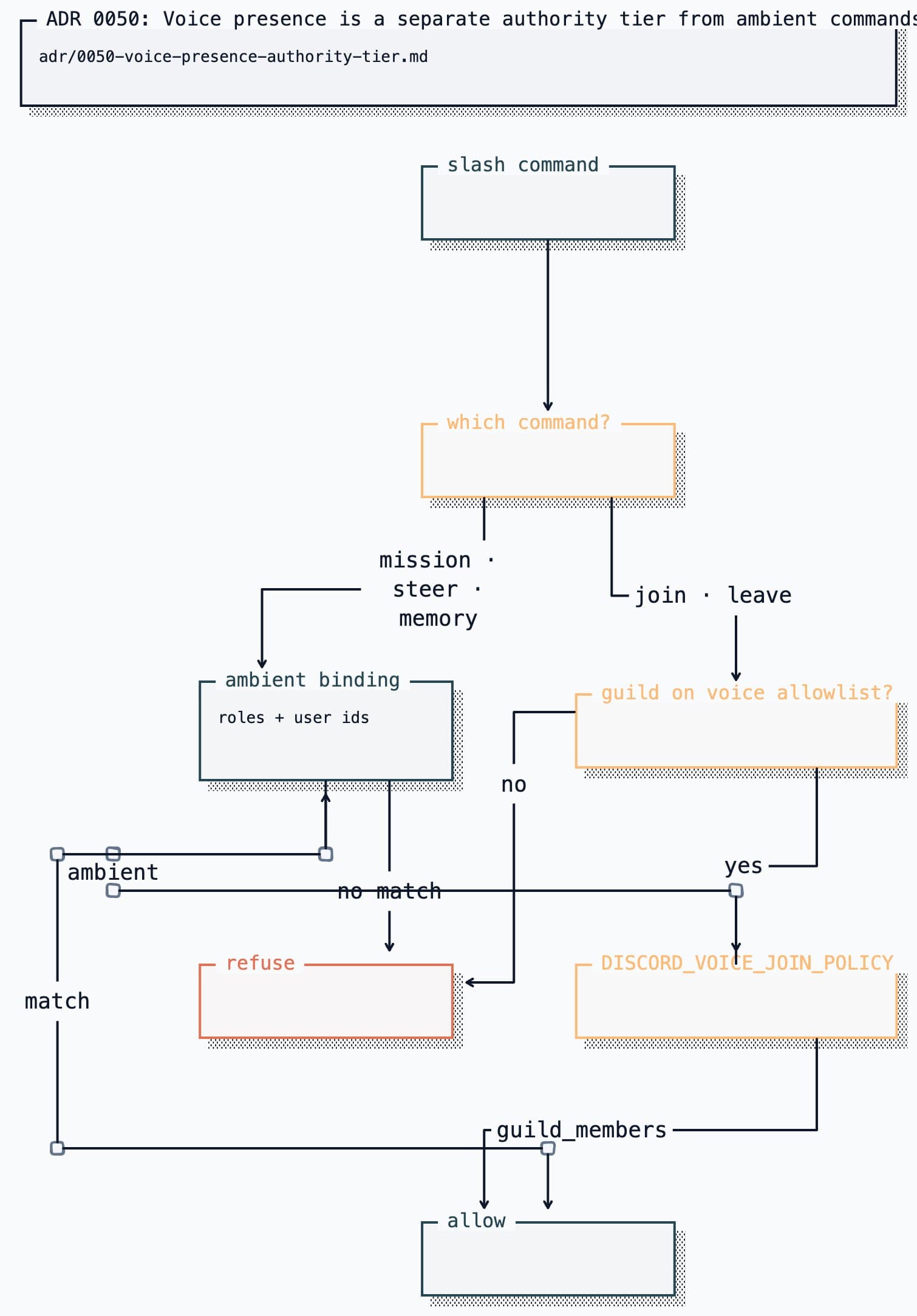
Voice presence receives its own actor policy. DISCORD_VOICE_JOIN_POLICY
selects ambient or guild_members, while DISCORD_AMBIENT_USER_IDS can name
individual ambient operators alongside role ids.
Editable Turbopuffer tldraw source
guild_members widens voice presence and nothing else. Guild and channel
allowlists still apply first, and leave cannot target a call in another guild.
Unrecognized or absent policy values resolve to ambient; the wider policy is
reachable only by selecting it exactly.
Alternatives considered
- Grant the ambient tier to everyone was rejected because it silently widened higher-consequence commands at ratification.
- Use one boolean was rejected because a named policy expresses the actor set and permits future policy values without contradictory flags.
- Create a binding per command was rejected as unnecessary; only voice had a demonstrated need to diverge.
Consequences
- Voice remains off by default and guild/channel allowlisted.
- Permission to join never implies permission to capture; the voice consent policy remains separate.
- Spoken input remains an ambient social surface and does not grant system-tool authority.
- Current configuration belongs in the Discord bridge operating guide.