
ADR 0039: GBA emulator embodiment and the deterministic core boundary
Status: accepted. The real-core follow-up described below shipped in ADR 0040.
Context
At ratification Clankie's embodiment stack had two governed game environments (Minecraft and a PokeMMO simulator) but no rules-clean target for real input control. PokeMMO client automation is prohibited by that game's macroing policy, so the live actuator must land against a game we are permitted to automate: a locally-emulated Game Boy Advance Pokémon game the operator is legally entitled to run. The adapter must inherit the environment-runtime governance invariants rather than growing a private action loop, and the VUH-905 verification rejection established that a scenario driver must derive decisions from observed state instead of replaying a script.
Decision
gba_emulator was added as a sibling provider profile in the strict v2
resource-bounds union. Each profile owns its own resource vocabulary.
Its bounds carry the determinism anchors — pinned core identifier, savestate
identity digest, RNG seed — plus per-action input/frame quotas and typed
emulator.gba.* capabilities. No Minecraft or PokeMMO field appears in the
emulator contract.
The adapter (integrations/gba-emulator) is an EnvironmentAdapter dispatched
by EnvironmentRuntime. The runtime's generic dispatch branch carries the
command; the adapter parses the strict emulator contract at its boundary and
fails closed on anything malformed, over-limit, ungranted, paused, stopped, or
uncertain. Actions are bounded button press-for-frames, frame advance, and
cancellable wait; observations are strict unions over overworld, menu, party,
battle, dialog, danger, action state, and a bounded artifact://
framebuffer/RAM-state reference. Evidence is a bounded hash-chained trace keyed
by RAM-state digests.
The scenario driver is state-derived: decideNextGbaAction is a pure function
of the latest observations (route step from observed position, dialog advance,
battle cursor movement toward the strongest observed legal move), every action
flows through EnvironmentRuntime.startAction, and each dispatch is verified
by re-observation before the next decision. Uncertain or stale observations
pause the session and fail closed rather than replaying input.
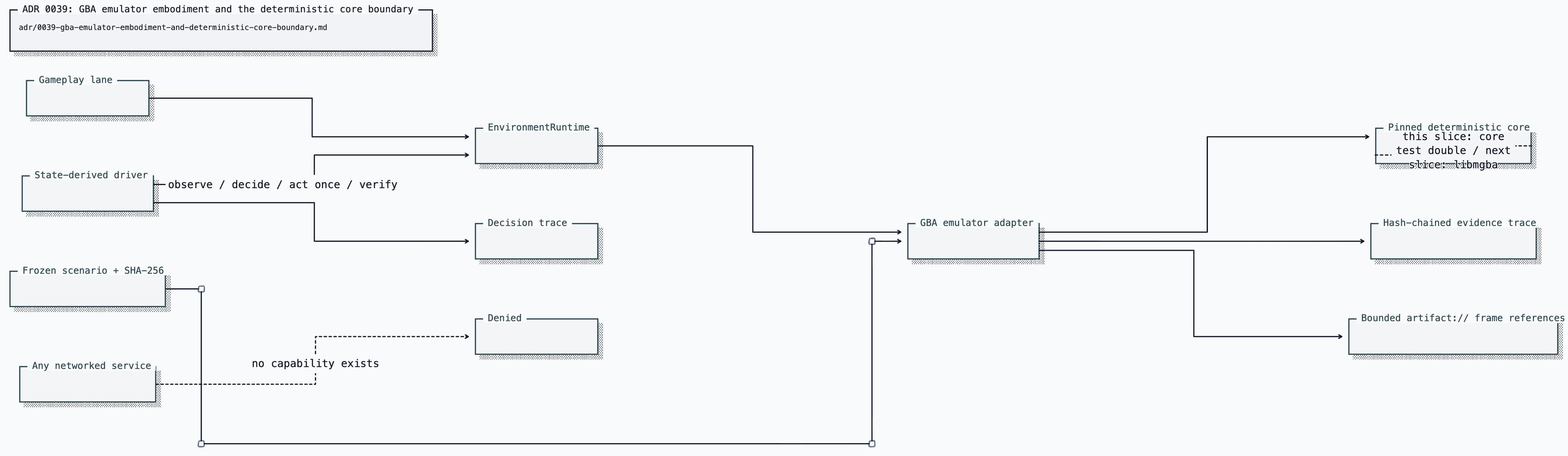
What this slice does and does not do
This slice drives DeterministicGbaCoreDouble, a clearly-labeled test
double for the emulator core: test infrastructure, not a product simulator.
It stands in for the pinned real core behind the exact adapter-facing seam the
real core will occupy — button input consuming frames, a typed RAM-derived
state view, and framebuffer/RAM digests — so the adapter, driver, runtime
governance, and frozen-scenario evidence are proven byte-for-byte replayable in
CI without a ROM. No real emulator process, ROM, BIOS, or savestate is
involved yet.
Real-core integration path (subsequently delivered)
The pinned core becomes headless mGBA driven in-process through its scripting/embedding surface (libmgba bindings), preferred over RetroArch because mGBA exposes deterministic frame-stepped control without a frontend:
- input injection: set the GBA keypad state for N frames through the core API —
the same press-for-frames contract
button_pressalready models; - observation: read the framebuffer after each step and decode fixed RAM addresses (position, party, battle state) into the existing strict observation union; raw frames/RAM stay on the artifact plane as digests and bounded references;
- determinism: pinned core build, fixed BIOS-free boot, load from the pinned
savestate whose bytes hash to the recorded
savestateSha256, seeded RNG, and frame-stepped execution (no wall clock); - RetroArch/libretro remains the fallback if libmgba embedding proves impractical; the adapter seam does not change either way.
ROMs are produced by the operator's own Universal-Randomizer workflow outside this repository; the adapter receives only local file paths via runner-private configuration, and ROM/BIOS/savestate bytes never enter model context, events, fixtures, or artifacts.
Options weighed
- Reuse the PokeMMO simulator profile with emulator meanings — rejected; one field must not serve two providers, and the acceptance boundary requires emulator-specific bounds.
- Drive a real emulator core in this slice — rejected for CI determinism and ROM licensing: CI cannot carry game binaries, and the governance/driver architecture is provable against a deterministic double behind the same seam.
- Script the scenario as a fixed input transcript — rejected; VUH-905's verification rejection established transcripts fake autonomy. Decisions must be computed from observed state and change when it changes.
- A dedicated emulator runtime beside
EnvironmentRuntime— rejected; it would not prove the shared lease, idempotency, cancellation, and emergency-stop architecture. - RetroArch network command interface for input injection — rejected for the default path; it introduces a local network socket where an in-process core API keeps the no-network-I/O boundary trivially provable.
Consequences
- Clankie gained a legitimate full-input embodiment target without widening the separately constrained PokeMMO boundary.
- The emulator contract, adapter, driver, and evidence pipeline were frozen and CI-proven before ADR 0040 swapped in the real core without changing the adapter surface.
- The capability boundary cannot represent network or live-service tampering, and tests assert the integration sources contain no network I/O path.
- Scenario evidence (report, hash-chained event trace, decision trace) is deterministic, bounded, and independently re-hashable.