ADR 0025: ClankVox is an in-repo voice sidecar behind versioned bridge IPC
Status: superseded. ADR 0128 governs the current sole-owner process/role model; owned native media placement, licensing, and the live IPC client use ADR 0100. The proposal and diagram below remain historical.
Context
ClankVox is the Rust media sidecar carried selectively from the v1 Clankie repository. The v2 bridge needs Discord voice WebSocket/UDP, RTP/Opus pacing, transport encryption, DAVE, inbound speaker audio, and transport health without inheriting the v1 brain, its Go Live/video and user-token implementation, music/YouTube, or player-control surfaces. ADR 0024 keeps Go Live in v2 as a separately gated personal-lab capability; this ADR does not import that capability into the core voice boundary.
The source snapshot is Volpestyle/clankie@04734df9ec1ec4665a233c4c64f0a51a9d3b0b83, path
clankvox/, Git tree 11f24ddcfc3ee62d45b83638e788877f39cd8fdc. VUH-805 records
file-level provenance when it performs the selective import.
Decision
The design below is retained as the superseded proposal. It is not the live
wire contract: the imported process uses the unversioned command/event contract
defined together by apps/vox/src/ipc.rs and @clankie/vox-client under ADR 0100.
Placement and import boundary
The executable lives at apps/clankvox/ as an in-repository Cargo crate with a pnpm package
facade. The crate and lockfile are reviewed and built with the rest of the repository; CI produces
platform-named binaries from source. VUH-805 creates the directory, Cargo crate, package facade,
provenance record, offline smoke fixtures, and build job atomically. VUH-804 deliberately does not
leave a README-only workspace directory because arch:check requires every apps/* directory to
be a complete package.
Vendoring remains gated on the owner's licensing disposition. The upstream crate declares
AGPL-3.0-or-later, while this repository declares Apache-2.0. VUH-805 preserves the upstream
license and provenance unless the owner records another valid disposition; no import silently
relicenses the code.
The selective import retains voice RTP/Opus, PCM conversion and internal mixing, pacing,
transport AEAD, DAVE audio, speaking/capture state, and transport statistics. The only governed
outbound media input is generic audio. It does not retain v1 music/YouTube/player-control IPC,
Go Live, video, user-token paths, v1 Realtime orchestration, or transcript-pane naming.
User-session Go Live and transport-agnostic Discord presence were assigned to
ADR 0024. The later receive/publish work
shipped through
ADR 0098 (user-session shares)
and ADR 0100; it did not fold
user credentials or video into this superseded schema-1 bot-only media plane.
One Discord media owner
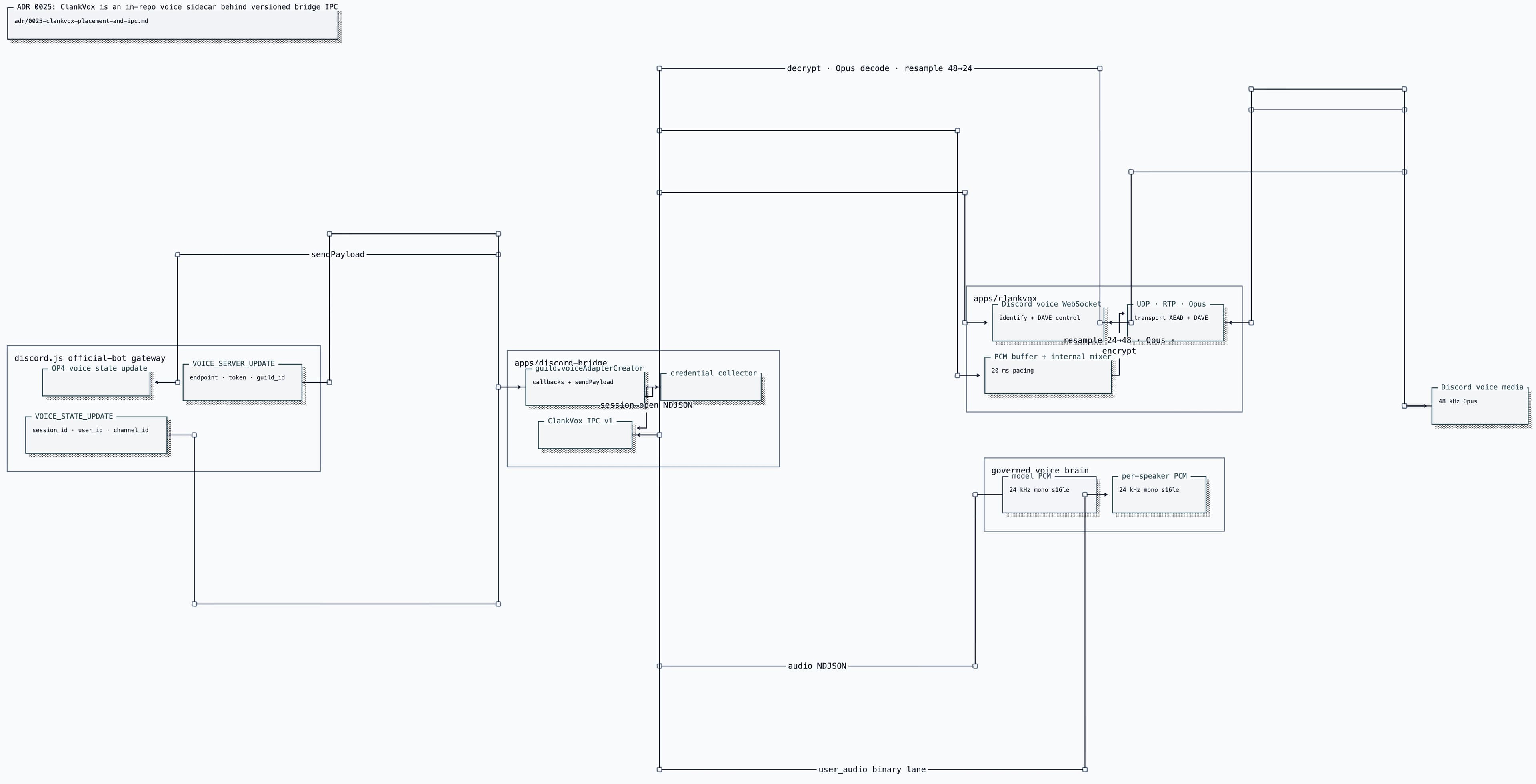
The bridge invokes guild.voiceAdapterCreator(callbacks) directly. It uses the returned
sendPayload to send Discord gateway OP4 voice-state updates for join and leave, collects
VOICE_SERVER_UPDATE and the bot's VOICE_STATE_UPDATE, then sends one complete session_open
to ClankVox. The bridge does not call joinVoiceChannel() for a ClankVox-backed session.
This distinction is structural. In the locally installed discord.js@14.26.4,
Guild#voiceAdapterCreator registers the supplied callbacks and returns sendPayload backed by
the guild shard. In @discordjs/voice@0.19.2, VoiceConnection supplies callbacks to an adapter,
collects both gateway packets, and configureNetworking() constructs its own Networking
instance. Using joinVoiceChannel() would therefore create a second voice WebSocket/UDP owner
that competes with ClankVox.
The gateway packets are sufficient for the official-bot media handshake:
VOICE_SERVER_UPDATEsuppliesendpoint,token, andguild_id(serverId).- the bot's
VOICE_STATE_UPDATEsuppliessession_id,user_id, andchannel_id(daveChannelId); - the bridge already authenticates as the official Discord application bot and never accepts a normal-user token.
Local dependency source also supports the DAVE shape: @discordjs/voice@0.19.2 constructs its
voice Networking from exactly those fields, advertises max_dave_protocol_version by default,
and creates DAVESession(protocolVersion, userId, channelId). The v1 ClankVox snapshot constructs
its DAVE manager from the same user_id and voice channel_id. This confirms credential-field
sufficiency, not live interoperability. VUH-807 must prove dave_state=ready and audible outbound
voice using bot credentials only before the path is treated as live-proven.
IPC transport
@clankie/vox-client and apps/vox/src/ipc.rs now own the live adapter
contract under ADR 0100.
Node to Rust is newline-delimited UTF-8 JSON. Each complete line, including its newline, is capped
at 8 MiB. The reader discards an oversized line through its newline, emits input_too_large, and
continues; malformed UTF-8/JSON produces a typed error without terminating the process. Binary
PCM accepted by the TypeScript API is encoded as base64 before it reaches this NDJSON wire.
Rust to Node uses a fixed five-byte frame header:
+---------+----------------+-----------------------+
| lane:u8 | length:u32 LE  | payload:length bytes  |
+---------+----------------+-----------------------+
length covers payload bytes only and is capped at 32 MiB before allocation. Unknown lanes,
oversized lengths, malformed lane payloads, and incompatible schema versions fail closed; VUH-806
owns child termination and restart policy.
| Lane | Value | Payload | Delivery semantics |
|---|---|---|---|
| control | 0 | versioned JSON lifecycle, speaking, end, and error events | ordered, must deliver |
user_audio | 1 | binary header plus mono s16le PCM | lossy under backpressure |
| log | 2 | versioned structured JSON log event | best effort, secrets redacted |
| health | 3 | versioned JSON health and transport-stat snapshots | latest usable snapshot |
Every JSON command and event carries integer schemaVersion: 1. Additive optional fields may
retain version 1. A breaking semantic, field, lane, or binary-layout change increments the version.
During migration, adapters may dual-read the current and immediately previous version, translate
to the current in-memory type, and single-write the current version. Unknown versions never fall
back to best-effort interpretation.
One ClankVox process owns at most one Discord voice session. Session-scoped output therefore does not repeat a session identifier; the bridge binds process identity to its session lifecycle.
Node-to-Rust commands
| Type | Fields | Meaning |
|---|---|---|
session_open | endpoint, token, serverId, sessionId, userId, daveChannelId, sampleRate | Open the one official-bot voice media session. sampleRate is the model-facing PCM rate. |
audio | encoding="pcm_s16le_base64", pcmBase64, sampleRate | Queue generic mono assistant PCM. The sidecar owns 48 kHz conversion, mixing, Opus, pacing, and encryption. |
health_request | none | Request an immediate health snapshot without waiting for periodic transport stats. |
session_close | optional reason | Stop media, close WS/UDP, zero session credentials, and settle the process session. |
There is no v1 join, gateway-fragment, music, player, stream-watch, stream-publish, video, or
user-token command in version 1.
Rust-to-Node events
Control JSON includes process_ready, session_state (including explicit daveState),
speaking_start, speaking_end, user_audio_end, and typed error. Health JSON includes
health_snapshot (including daveState) and
transport_stats; audio-only stats retain cadence, IPC drops, inbound decrypt/loss/concealment,
outbound RTP, and DAVE encryption failures. Log JSON contains level, target, message, and
bounded structured fields; endpoint, token, session identifiers, raw private audio, and prompt
content are never logged.
user_audio is the only binary event. Its schema-1 payload preserves the v1 18-byte little-endian
header exactly:
| Offset | Width | Field |
|---|---|---|
0 | 8 | Discord userId as unsigned u64 LE |
8 | 2 | signalPeakAbs as u16 LE |
10 | 4 | signalActiveSampleCount as u32 LE |
14 | 4 | signalSampleCount as u32 LE |
18 | remaining | mono s16le PCM at the active session's model-facing sample rate |
The binary payload version is selected by the process's schema-1 contract; it does not add a
second version word to the v1 header. user_audio_end closes the current per-speaker PCM burst.
Options weighed
- Git submodule — rejected because clean checkout, CI, provenance capture, atomic IPC changes, and offline verification would depend on a second repository state and submodule update flow.
- Prebuilt released binary — rejected because it weakens source review and reproducibility, complicates platform/architecture coverage, and separates contract changes from their binary.
- External sibling checkout — rejected because it makes local machine layout part of the product and cannot satisfy clean-checkout builds.
- Library embedded in the Node process — rejected because Rust media failures, native linking, pacing, and backpressure need a process boundary and independent lifecycle.
joinVoiceChannel()with a custom adapter — rejected because@discordjs/voicecreates its ownNetworkingafter the two gateway packets arrive.- Raw v1 IPC without a version — rejected because Rust and TypeScript could silently drift.
- Carry v1 music/player commands — rejected because they contain brain/product policy and are not required for the governed outbound PCM boundary.
Consequences
- ADR 0100 records and preserves the AGPL package license and exact source provenance for the imported native implementation.
- ADR 0128 replaces the later
@discordjs/voicepath with one Vox child behind the direct gateway/client boundary for either media-enabled active body; a text-only official-bot process starts no media child. - The isolated, opt-in user-session transport and shipped Go Live receive/publish path are owned by ADR 0098 (user-session shares) and ADR 0100, preserving the single-owner invariant.