
Settings System
Canonical reference for how settings are authored, stored, resolved, served to the dashboard, and applied to the live runtime.
Companion docs:
../architecture/presets.mdfor preset-specific defaults and product intent../architecture/overview.mdfor the broader runtime architecture../voice/voice-provider-abstraction.mdfor voice-specific stage behavior../capabilities/browser.mdfor browser-runtime behavior../capabilities/code.mdfor code-agent behavior../capabilities/minecraft.mdfor Minecraft runtime behavior and brain ownership
1. Mental Model
The settings system has four distinct layers:
-
intent- The operator-authored settings snapshot.
- This is the only settings data that is persisted.
-
effective- The fully normalized runtime settings after preset defaults, canonical fallbacks, clamping, and coercion are applied.
- This is the object the runtime actually reads.
-
bindings- Derived runtime helpers for the dashboard and debugging.
- Examples: resolved orchestrator binding, voice generation binding, voice runtime family, provider auth availability.
- Bindings are computed from
effective. They are never persisted.
-
Control metadata
- Save version, runtime-apply status, and similar control-plane state.
- This is not part of the settings model itself.
The critical rule is: authored settings, resolved runtime state, and control metadata must stay separate.
2. Persistence Contract
The canonical settings row lives in SQLite:
- table:
settings - key:
runtime_settings - value: authored settings intent JSON
- version:
updated_at
The database does not store materialized preset fallbacks or dashboard-only resolved helpers.
Before settings are written, the store minimizes the authored snapshot through src/settings/settingsIntent.ts. Any authored field that can be removed without changing normalized runtime behavior is stripped before persistence.
That means:
- unset inherited fields stay absent
- save operations do not freeze preset defaults into sticky overrides
- dashboard/runtime helper fields never leak into storage
3. Dashboard API Contract
GET /api/settings returns a settings envelope:
{
  intent,
  effective,
  bindings,
  _meta
}
Current meanings:
intent: persisted operator-authored snapshoteffective: normalized runtime settingsbindings: resolved runtime helpers for display/debugging_meta: version and save/apply metadata
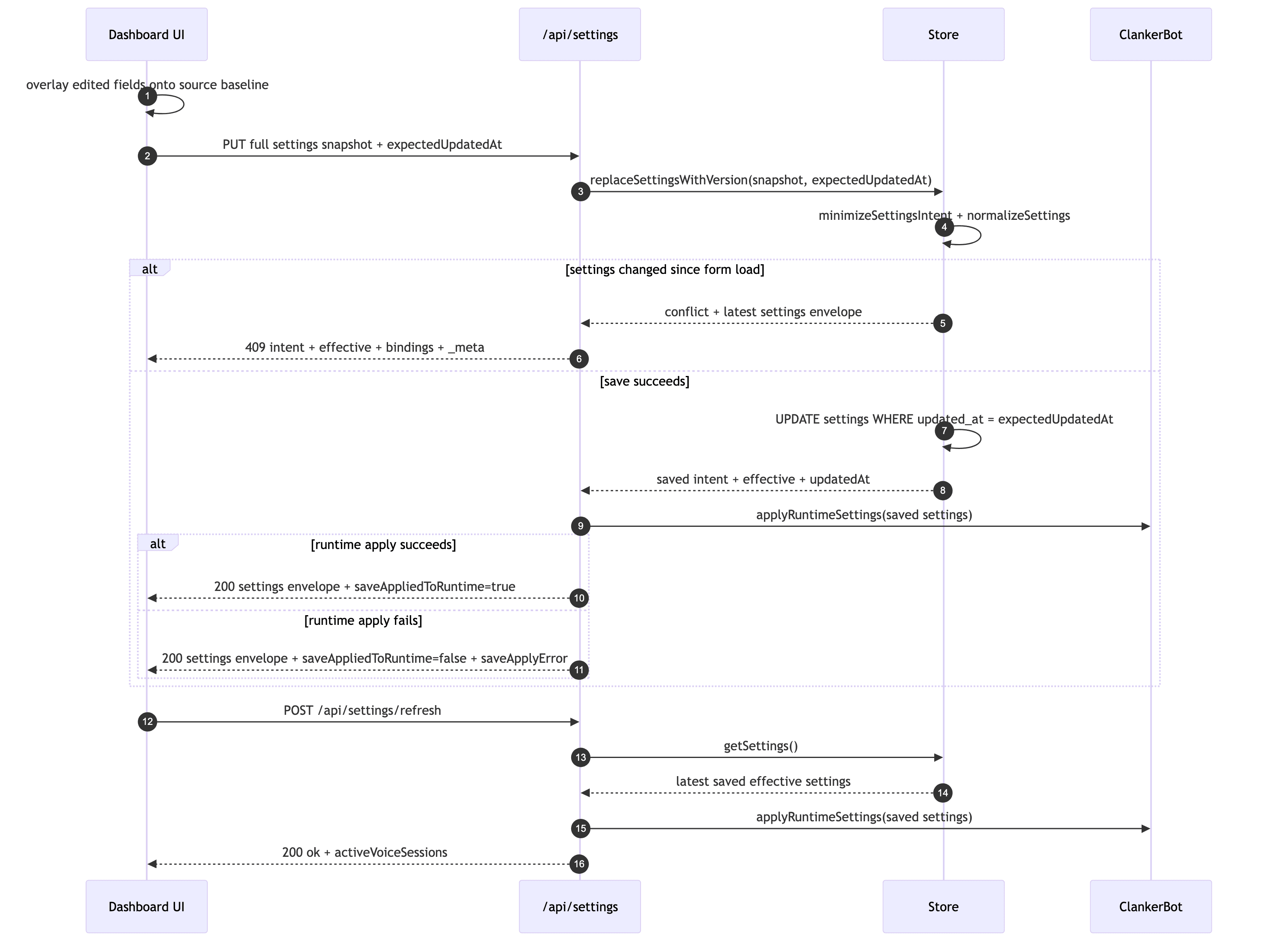
The dashboard edits intent. It uses effective and bindings as a runtime preview, but on save it materializes and submits the next full authored snapshot instead of sending a sparse intent patch. The form model starts from the normalized source settings and overlays dashboard-edited fields onto that baseline so settings the UI does not expose are preserved across ordinary dashboard saves.
If the saved settings snapshot changes while the dashboard form has unsaved edits, the form keeps the operator's draft and surfaces an inline warning. Saving stays disabled until the operator discards the draft and loads the latest saved settings, or until the incoming snapshot matches the draft after a successful save.
PUT /api/settings accepts:
- the next full authored
intentsnapshot in the request body _meta.expectedUpdatedAtfor optimistic concurrency
Save semantics:
- the request body replaces the full authored snapshot
- dashboard saves preserve non-rendered settings from the form's source baseline unless a visible control edits or clears the related branch
- branches omitted by direct API clients revert to defaults or inherited runtime behavior after normalization
- this is not merge-patch behavior
Current save guarantees:
- saves are compare-and-swap on
settings.updated_at - stale tabs get
409 - missing version metadata is rejected
- persistence and live-runtime apply are separate outcomes
- a save can succeed even if live voice sessions fail to reconcile immediately
- successful live apply rebinds active voice-session timers and refreshes realtime tools/instructions for sessions that support hot updates
POST /api/settings/preset-defaults returns a preview envelope for a selected preset. Save is still required before that preview becomes persisted intent.
POST /api/settings/refresh reapplies the last saved effective settings to the live runtime. For active voice sessions, it hot-refreshes session timers plus realtime tools/instructions where the provider supports in-place updates. It does not apply unsaved form draft state.
4. Resolution Pipeline
Canonical pipeline:
Persisted intent
  ↓
Intent minimization (`src/settings/settingsIntent.ts`)
  ↓
Normalization (`src/store/settingsNormalization.ts` + `src/store/normalize/*`)
  ↓
Resolved runtime bindings (`src/settings/agentStack.ts`)
  ↓
Dashboard envelope (`src/settings/dashboardSettingsState.ts`)
Responsibility split:
-
src/settings/settingsSchema.ts- canonical settings shape and defaults
-
src/settings/settingsIntent.ts- strips redundant authored fields before persistence
-
src/store/settingsNormalization.ts- canonical normalization entrypoint
-
src/store/normalize/*- section-specific coercion, bounds, and fallback logic
-
src/settings/agentStack.ts- preset/runtime resolution and derived model/runtime bindings
-
src/settings/dashboardSettingsState.ts- dashboard envelope and resolved dashboard-facing bindings
5. Top-Level Settings Map
Top-level persisted groups:
identitypersonapromptingpermissionsinteractionagentStackmemorymemoryLlminitiativevoicemediamusicautomations
High-level ownership:
| Group | Primary responsibility |
|---|---|
identity, persona, prompting | model context and presentation |
permissions | deterministic safety and access control |
interaction | text reply budgets, sessions, startup/catchup |
agentStack | preset selection, runtime families, model/runtime bindings |
memory, memoryLlm | durable memory behavior and retrieval/generation bindings |
initiative | ambient text and voice initiative cadence |
voice | conversation policy, admission, transcription, channel/session limits, soundboard |
media | vision and video context |
music | playback ducking/runtime-adjacent music behavior |
automations | scheduled autonomous work |
At the product level, permissions is not just a raw allow/block layer. It is the deterministic enforcement surface for Clanky's relationship model: broad community-safe capabilities in shared Discord spaces, higher-trust collaborator capabilities for approved users on approved resources, and owner-scoped device capabilities for the operator's local instance. The conceptual model lives in ../architecture/relationship-model.md.
6. Presets And Overrides
Presets are starting points, not an alternate storage system.
Rules:
agentStack.presetselects the preset definition- preset defaults seed missing values during normalization
- explicit overrides are authored in
intent effectiveis the combination of preset defaults plus authored overrides- removing an authored override should return the field to inherited preset behavior
- when multiple sources can supply the same runtime choice, explicit authored runtime config wins over preset defaults
Important consequence:
- the store should never persist a preset-derived value just because the dashboard displayed it
Preset-specific default choices and product intent live in ../architecture/presets.md.
7. Feature-Local Settings Docs
docs/reference/settings.md is the canonical cross-cutting contract. Feature docs still own the meaning of feature-local knobs:
- browser runtime knobs and behavior:
../capabilities/browser.md - code-agent knobs and behavior:
../capabilities/code.md permissions.devTasks.allowedWorkspaceRootsis the approved local filesystem boundary for code workers; when a workerdefaultCwdis unset, the first root also becomes the default cwd, and GitHub issue/repo URLs are resolved only against local clones under these roots- Minecraft runtime knobs and brain binding:
../capabilities/minecraft.md agentStack.runtimeConfig.devTeam.swarmis the swarm-mcp coordination wiring for local code workers (the substrate, not an opt-in);allowDirectChildFallbackdefaults tofalseso workers require attachable swarm-server PTYs unless the operator explicitly permits headless fallback. Its behavioral contract lives in../capabilities/code.mdagentStack.runtimeConfig.minecraft.serveris the canonical preferred world/server target for embodied Minecraft sessions; its behavioral contract lives in../capabilities/minecraft.md- voice transport and pipeline knobs:
../voice/voice-provider-abstraction.md - activity/attention-facing behavior knobs:
../architecture/activity.md
Those docs explain what a setting means behaviorally. This doc explains how settings exist as data.
8. Rules For Future Changes
When adding or changing settings:
- persist operator intent only
- do not save resolved fallbacks back into storage
- keep derived helpers in
bindings, not in persisted settings - keep control-plane data separate from the settings payload
- add new normalization logic in canonical section normalizers instead of dashboard-only mappers
- document the feature-local meaning in the relevant feature doc
- document any cross-cutting contract change here
The failure mode to avoid is a hybrid payload where authored settings, resolved runtime state, and dashboard control metadata are mixed together and then accidentally re-saved as if they were all operator intent.