ADR 0135: A Herdr agent has a direct conversation
Status: accepted (James, 2026-08-28). Amends the no-bespoke-Herdr-tools decision in ADR 0097 a second time (the first was ADR 0131), extending the service's herdr machinery from one lifecycle bridge to a fleet conversation projection. ADR 0147 defines the durable persona that owns the conversation while a Herdr seat is its current terminal address. Closes the "per-agent send has no transport" gap recorded in the app repo's ADR 0012 (worker transcripts on the conversation stream). ADR 0149 amends the fleet-acquisition story: the led session is chosen in settings and an unseated operator turn also carries the census; sitting in a pane remains what makes a pane him.
Context
The app is re-centering on messaging: Clankie pinned as the operator's head of staff, every herdr agent a contact, threads instead of dashboards (the app repo's ADR 0013). The interaction model is Grok Bot's — named agents you message like coworkers — with one structural difference that is our strength: Grok gives each bot an isolated cloud computer, while every Clankie agent shares one machine, one filesystem, and one herdr session. The app is a window onto a real place, not a chat skin over N sandboxes.
The service already holds the fleet's state. A seated captain turn reads a
live census (herdr-census.ts), distilled per-pane summaries ride the
herd-lead summaries file (herdr-summaries.ts), and completion watches bridge
pane settlement into the operator queue (ADR 0131). The operator-conversation
registry already carries redacted, bounded, resumable conversation streams
through the relay to devices, and the app already renders them.
What is missing is the projection between the two: the fleet is not visible as
conversations, and a device cannot send text to a pane. The app-side product
rule that forbade free-form worker steering ("a finite set of typed intents,
never free-form text-to-command") is retired by the product lead with this
decision. The auth boundary it was guarding is unchanged — a device bearer
with a chat grant already reaches Clankie, who holds machine tools, so
free-form text to a pane is the same power with less ceremony, not a new
power.
Decision
Herdr agent personas are projected through the existing operator-conversation registry and relay. No new service, route family, or credential.
Persona and seat identity
A persona is the durable identity a thread hangs off. Its harness-native occupant is replaceable. The host mints the persona id once and binds it to the immutable Herdr subject (a managed name, or an unnamed pane's stable fallback); the current harness session supplies a separate occupant id. A seat is the current Herdr terminal address and carries live status, cwd, and terminal routing. A dead pane renders the persona offline; its history stays. A replacement session presenting the same subject rebinds the persona without changing its thread.
Contract sketch
The registry contract grows three things, all inside the existing bounded, redacted schema discipline:
// 1. Scope: a conversation belongs to a persona. Distinct from the existing
//    "workspace" kind, which names a working directory.
OperatorConversationScope =
  | { kind: "global" }
  | { kind: "workspace"; workspaceId: string }
  | { kind: "persona"; personaId: string };    // one DM thread per agent

// 2. Roster: one bounded dispatch op for the contact list.
{ op: "roster" } → {
  seats: Array<{
    seatId: string;
    occupantId: string;
    personaId: string;
    harness: string;        // claude, codex, pi, … from herdr's agent field
    status: string;         // working | idle | done | blocked | offline
    title: string;          // pane title, bounded
    summary?: string;       // herd-lead distilled summary, when written
    next?: string;
    conversationId?: string; // the persona's thread
    workingDirectory?: string; // herdr's cwd; the district key for app ADR 0022
  }>;                        // capped like the census (48)
}

// 3. Attribution: the message event's role union gains the seat's voice.
role: "operator" | "captain" | "agent"

// 4. Closing a seat ends its pane without deleting the persona or thread.
{ op: "close_seat", seatId: string } → { seatId: string; closed: boolean }

// 5. Hiring is its symmetric twin: a tab in a working directory, a harness
//    started in it, and the seat it became. Both need the `steer` grant.
{ op: "spawn_seat", seat: { harness, title, workingDirectory } }
  → { result:
      | { outcome: "spawned"; seat: FleetSeat }
      | { outcome: "failed";
          reason: "unknown_directory" | "harness_unavailable"
                | "not_ready" | "herdr_unreachable";
          detail?: string } }

// 6. Composer discovery follows the conversation target, not app-global state.
{ op: "composer_catalog", conversationId: string }
  → { catalog: {
      commands: Array<{ name, aliases, summary, argumentHint? }>;
      skills: Array<{ name, description, source, invocation }>;
    } }
spawn_seat runs herdr tab create --cwd then herdr agent start --kind,
which returns only once herdr has detected the harness and considers it ready
for input — so a spawned result means the seat can actually be messaged. A
harness takes input before it has written the session file herdr reports as its
identity, so the spawn waits out that gap rather than reading identity once.
The harness is an enum, not a string, because it reaches an exec. Failure is
typed rather than thrown: a surface renders it and keeps the operator's draft,
and a start that fails closes the pane it opened so retries do not accumulate
empty tabs. The new seat is tracked the moment it exists, the way a create
with a persona scope tracks one, or its first reply lands in a thread nothing is
listening to.
create with a persona scope is idempotent per persona, like the default global
conversation. send to a persona conversation resolves its current seat and
hands the text to that seat's mailbox when a channel bridge is polling it, and
otherwise pipes it to the pane (herdr pane send-text + Enter)
(ADR 0161) — a
direct lane, no captain model turn. A persona with no live seat rejects the
send with a typed failure; the thread stays readable.
composer_catalog resolves through the same address. A Clankie conversation
reports the Pi resources its captain session loads. A persona conversation
reports skills visible to the current seat's harness and working directory,
with the exact invocation token the harness accepts ($name for Codex,
/name for Claude, /skill:name for Pi). Codex discovery uses its native
skills/list app-server method, including enabled plugin skills, and fails soft
to the same filesystem roots used for other harnesses when that method is not
available. An offline persona and a channel return empty target catalogs.
Commands are restricted to operations whose effect belongs in the message
lane; terminal-only menus remain in the terminal.
What becomes bubbles
A pty stream is not messages. The persona thread carries the readable projection, built from signals the service already has:
activityevents from agent-status transitions —workingis literally a typing indicator;done/blocked/idleare delivery states.messageandtoolevents from the harness-native session tree. Herdr's resume identity selects Claude Code, Codex, and Pi sessions. Grok's exact foreground PID selects the matching entry in its native active-session registry, so two panes in the same working directory cannot cross-wire. Each active branch is folded in full, in order, with user text attributed tooperator, assistant text attributed toagent, and every tool start/result joined by its native call id. Tool arguments and results are redacted and bounded before they enter the durable log; the short row stays compact while every surface can expand the typedtool.detail. Injected instructions and reasoning never enter the public stream. Raw PTY parsing remains outside this lane.- Stable native entry ids checkpoint each session. A working pane's session tree is re-read on a short tail as well as on status changes, so each message and tool call reaches the thread while the agent is still working rather than when it settles. Re-reading is idempotent, the subject binding keeps a replacement session on the durable persona, and the first native import replaces the old one-answer seed behind a typed cursor-recovery boundary.
- The tail costs the append, not the session. Codex and Grok rollouts are append-only logs whose records normalize independently of their neighbours, so the reader remembers the byte offset of the last complete line and folds in only the new bytes — carrying tool names, the dedupe set, and the positional id base across chunks, which keeps a tailed read identical to a whole-file parse. Claude and Pi transcripts are walked as a parent chain that an append can re-root, so they rebuild from the whole file when it changes and do no work at all when it has not. A shrunk file, a new inode, or a same-length rewrite in place is rewritten history rather than an append, and resets the tail.
- A harness without a native transcript normalizer retains the bounded summary/final-answer projection. Adding its normalizer upgrades the same conversation without changing the relay or app.
- The operator's own sends publish immediately and reconcile with the same prompt when it appears in the native session tree.
Raw scrollback never enters the message lane. Full-screen alternate buffers and primary-screen scrollback therefore behave the same: session history supplies chat, while the terminal destination remains the raw-truth path over its existing transport, one tap from the thread.
Transparency
Persona conversations are not side channels. The captain can list and replay them like any conversation — the lead sees everything his branches do, he is just no longer a mandatory relay hop for steering them.
The full cross-repo picture — both repos, the trust boundary, the send and projection loops, and the retired terminal transport:
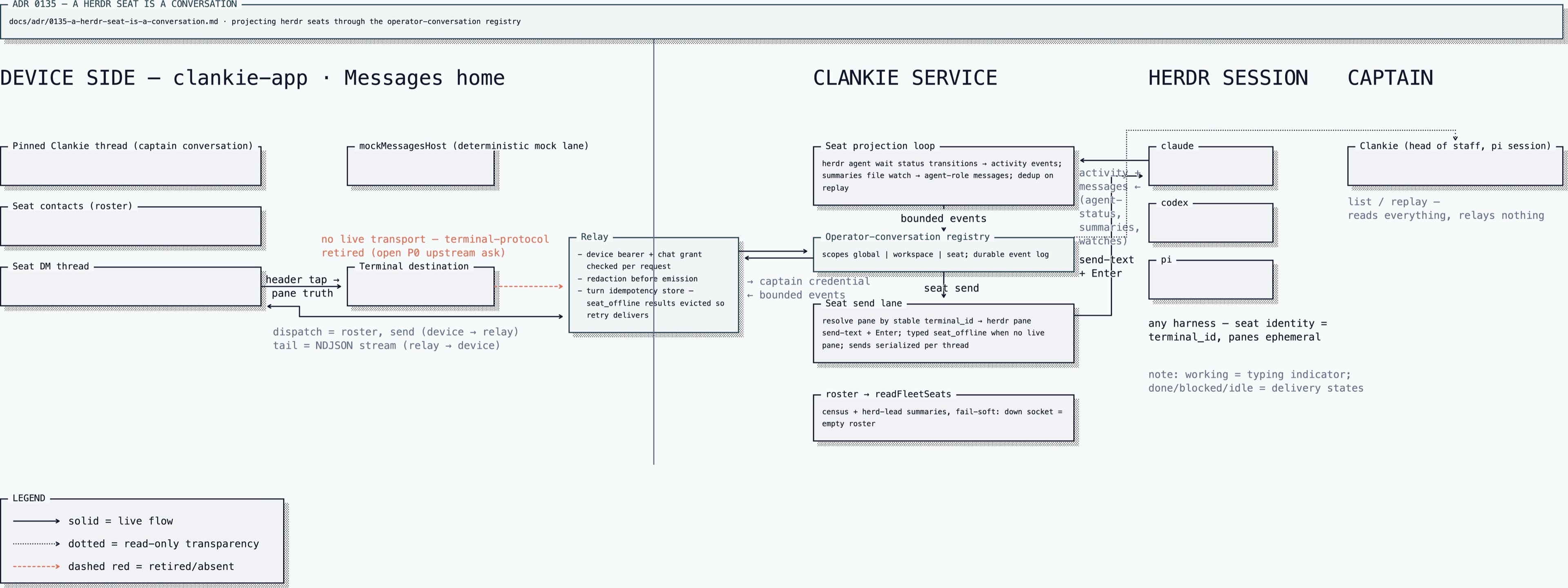
Editable turbopuffer tldraw source
Channels and compose-to-spawn reuse the same persona, scope, roster, and direct send machinery. A channel contains personas; only its live routing resolves through seats.
Alternatives considered
- Every message routes through Clankie. The lead as mandatory relay hop. Rejected: it burns a model turn per steering message, serializes the fleet behind one conversation, and adds nothing — his visibility is preserved by reading, not by forwarding.
- A separate herdr-bridge service or new route family. Rejected: the registry and relay already carry authenticated, redacted, cursor-resumable conversation streams end to end. A second surface is a second credential story — avoiding that is exactly what the app's ADR 0012 valued about this transport.
- Raw pty output as the message stream. Rejected: scrollback is not messages, and the app already has a real terminal for truth. The thread is for words; the terminal is one tap away.
- Keep the typed-intents rule and enumerate steering verbs. Rejected by the product lead: the fleet's harnesses are conversational agents; a finite verb set is a worse interface to them than language, and the auth boundary never depended on message shape.
Consequences
- The app's per-agent send gap (its ADR 0012) closes with no new backend surface: configuring live captain chat configures the fleet lane.
- Any harness gets a messageable DM from the pane contract. Claude Code, Codex, Pi, and Grok also supply complete native message and tool history; other harnesses retain their safe summary projection until they gain a transcript normalizer.
- Closing an agent is a seat operation guarded by the device's
steergrant: it closes the current Herdr pane and removes the live roster entry while the persona and durable thread remain available offline. - ADR 0097's "no general herdr tool suite" holds for captain tools; the service's herdr machinery nonetheless grows a standing projection loop (roster cache, seat watchers, native transcript folding) that must fail soft the way the census does — a down herdr socket renders seats offline, never a failed conversation surface.
- Message role gains a third variant, so older app builds render seat messages through their existing forward-compatibility path until they update.
- The app repo's product direction retires the typed-intents sentence in the same change that adopts its ADR 0013.