ADR 0103: A hosted world is another body, behind a pinned contract
Status: accepted (James, 2026-08-19). Amends ADR 0102, which decided the world would be reached only through the packaged MCP server. The shipped code (VUH-970) reaches it through the pinned world contract instead; this record states the boundary that is actually built and enforced.
Amended in the mechanism, not the boundary (2026-08-16): the contract is now
the published package @pokeagents/world-protocol at a version, not a git
revision pinned against a private repository. PokeAgent MMO
ADR 0014
publishes the client kit under the @pokeagents scope; its private host
packages keep @pokeagent-mmo, so the scope now marks the boundary this record
is about. Everything below about what may be imported still holds, and the
pinned in the title now means a pinned version.
Current status (2026-08-26)
The code described here is shipped. ADR 0129
clarifies that hosted co-play uses separately credentialed player seats and that
MCP is only a transport projection for other harnesses. The sibling PokeAgents
repository ships the operation catalog and derives its MCP tools from it.
Clankie's current boundary imports only @pokeagents/world-protocol and /ipc;
host packages remain forbidden. Hosted play composes WorldPlayerClient for
transport, session, retry, and frame order; the adapter maps observations into
the GBA driver and publishes Activity media. Granted session, presence, travel,
and challenge operations are available through pokeagent_world. Emerald
adapter version 2 is a supported semantic profile at that existing adapter
boundary: HostedWorldBody selects schemas by (gameId, adapterVersion)
rather than assuming FireRed.
Context
ADR 0102 treated PokeAgent MMO as a tool surface: Clankie would call
@pokeagent-mmo/world-mcp through his generic MCP client and wrap the results.
That is the right shape for a harness whose relationship to the world is
tool calls.
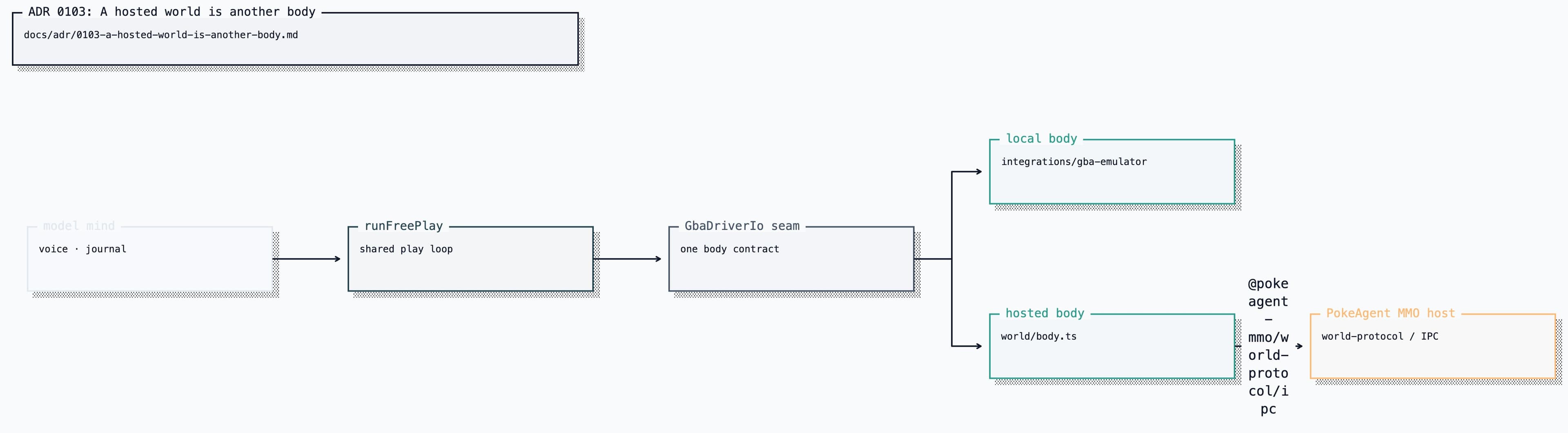
Clankie's relationship to a game is not tool calls. runFreePlay drives exactly
one seam — GbaDriverIo — and the behavior above it (the model mind, voice,
interjections, and minted progress) does not branch on where the body is. Its
shared journal accepts body-aware provenance for causal evaluation; that is
evidence about the seam in use, not a second body-specific loop. The activity
publish path underneath it is equally concrete: a frame source with
digest dedupe so an idle screen costs no bandwidth, and dropped frames counted
rather than swallowed.
Reaching a hosted world through MCP tool calls would not have reused that. It would have produced a second play loop beside the local one — a second frame path, a second journal, a second set of interjection rules — to say the same things about a different body.
Decision
A hosted world is a second implementation of the GbaDriverIo seam plus a
rendered-media source, composed by the same execution the local body already
uses. It is not a second play loop.
The shared loop consumes the hosted walk's bounded route detail plus its fresh
after-state. inputsSpent remains button presses and is never relabeled as tile
steps; partial movement is a ran-but-incomplete action, not a rejection and not
an arrival.
Clankie reaches the world through the version-pinned
@pokeagents/world-protocol package, using the client transport on its /ipc
subpath. apps/clankie/src/world/body.ts holds the seam;
apps/clankie/src/play-execution-world.ts composes it.
The operator- and Discord-visible surface is one captain tool, pokeagent_join_mmo.
The pinned player contract supplies control and frames. Ephemeral game sound stays on the world's spectator-media boundary: the body mints its own unlisted watch grant, reads live PCM with that read-only capability, and forwards bounded packets to the Activity. This keeps spectator media out of the agent protocol without creating a second emulator capture.
Adapter-owned state evolves behind that contract. The hosted body selects a
state schema by the observation's (gameId, adapterVersion) pair. FireRed
adapter version 2 includes the decoded new-game name menus, which the body
exposes through the same menu observation as local play. A successful hosted
menu action is rendered from that pre-action entry only after the host reports
that its live cursor reached and confirmed it. An incomplete selection is ran
with its press count, stopping reason, and fresh observation. Emerald adapter
version 2 publishes overworld position, party, dialog lines, and map size
through those same observation kinds; it does not publish FireRed's NPC list,
connections, or decoded menu entries, and those stay fail-closed rather than
inferred.
World protocol v3 separates exit topology from walk_to support. Unsupported
exits stay visible, trigger mechanics stay private, and the body returns a
target-local zero-input refusal. Composite actions that already spent input are
ran with incomplete detail, never success-shaped and never rejection-shaped.
The boundary that survives from ADR 0102 is the one that matters: Clankie is a
player in that world, not its owner (PokeAgent MMO ADR 0001). He does not import
the world server, emulator core, mailbox, or persistence packages, does not run
the host, and does not reimplement the wire format — he links the contract that
defines it. @pokeagent-mmo/firered remains usable as transport-free cartridge
knowledge. The world CLI remains an operator debugging fallback.
Editable Turbopuffer tldraw source
apps/clankie/test/pokeagent-mmo-boundary.test.ts enforces this: exactly
transport-free FireRed knowledge and the published
@pokeagents/world-protocol client contract may be imported by product source;
the host, server, and emulator packages may not be depended on at all.
The seat is a credential, not a config value. The bearer lives in the credential
broker under pokeagent_mmo_world, and CLANKIE_WORLD_CREDENTIAL in the
environment is refused even when the broker also holds an entry, so a weaker
ambient credential cannot silently win (credential guide).
Consequences
- The mind, voice, behavior loop, journal format, and activity publishing are shared across bodies. A hosted world inherits them rather than reimplementing them, while each journal packet names the body provenance sampled at its causal stages.
- Clankie tracks a pinned contract revision. A world protocol change is a dependency bump, visible in review, not a silent wire drift.
@pokeagents/world-mcpremains the path for harnesses that want tools, and remains what other agents use. Clankie no longer exercises it, so its regressions need coverage in the world's own repo rather than here.- Three realities a local body never had must be handled in the seam, not
papered over: there is no pause, because one player cannot stop a shared
world; the screen can change with no action of his; and a body can be replaced
under him by a region crossing or an operator takeover, which
bodyGenerationdetects and which invalidates everything cached about the screen. - Journal evidence samples hosted
bodyGenerationand semantic state at the decision, immediate pre-action, and post-action stages. Ambient world movement while the mind thinks is visible without being credited to the action (ADR 0117). - A refusal is something he can say out loud.
join_refusednames its reason —no_credential,world_unreachable,world_full,region_not_hosted,world_refused— andpendingmeans the world is still spinning up, never that he is playing.