
ADR 0093: Owner-authored service connections
Status: accepted (2026-08-15), amended in part by
ADR 0109. /connect is still the
catalog, Discord is still a body, mail is still operator-lane, and secrets are
still broker-owned. Two things below no longer describe what runs: "Generic MCP
is not a captain surface" is reversed, and Linear is reached over its MCP server
rather than through hand-written GraphQL tools and a default-team setting.
Context
Clankie is one agent per machine, configured by the person who runs him. An owner opens the console, connects Discord, Linear, or email, and the agent uses that owner-authored connection within the service's lane and authority bounds.
Three unlike things are being asked for under one word, "access":
| Service | What access means here | Existing path |
|---|---|---|
| Discord | He is present in the owner's servers | /discord — first-class body, not a tool |
| Linear | He can search and file issues | /connect linear |
| He can read and send the owner's mail | /connect email |
Options weighed:
- Generic MCP registry on the captain. Paste
npx @linear/mcp-serverand hope. Rejected as the primary path: ADR 0082 already put process ownership of MCP in the service, not the session, and a raw MCP add is not "easy" for someone who just downloaded him. - Browser login only. He already has a persistent browser profile. Rejected as the only path: it is access without tools, so "what's ENG-123?" becomes a scrape.
- First-class
/connectcatalog. Accepted. Curated connectors, brokered secrets, captain tools that refuse honestly when nothing is connected.
Decision
/connect is the catalog. Aliased as /integrations. /auth stays
provider keys and subscriptions; typing /auth mcp redirects here.
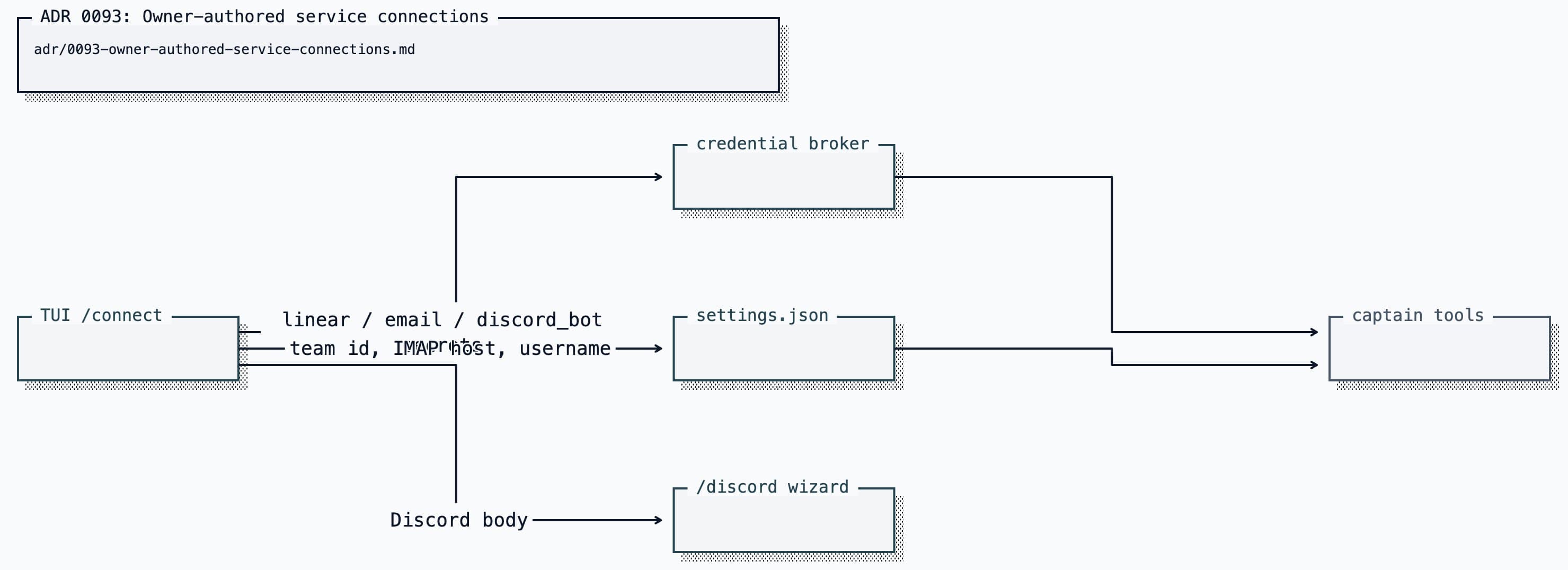
Discord remains a body. /connect discord opens the existing wizard and
adds a portal primer plus an invite URL derived from the application id. Any
user can create their own application; Clankie is not a hosted multi-tenant
bot they OAuth into.
Linear is a tool connector. /connect linear signs in with Linear's MCP
OAuth 2.1 (dynamic client registration + PKCE against mcp.linear.app) and
stores the tokens in the broker. That is the same authorization server Claude
Code and Codex use. A personal API key remains an advanced fallback. Tokens
are sent as Authorization: Bearer to GraphQL. Optional default team UUID in
settings. Tools: search, get, create, update, comment, teams. Available in
every room — that is why someone connects their tracker.
Email is IMAP/SMTP. Password in the broker (email); host and username in
settings. Presets for Gmail, iCloud, Fastmail, and Outlook, plus custom.
Gmail and iCloud need an app password; the wizard says so. Mail tools are
operator-lane only: listing, reading, searching, and sending from Discord
would dump a mailbox into a room. A Discord turn that calls them is refused
with operator_only.
Tools are always registered. They refuse with credential_unavailable or
not_configured when the owner has not connected them, the same shape
generate_image uses. Connecting mid-session does not require a restart.
Generic MCP is not a captain surface. The browser host remains the pattern
for a service-owned MCP process. A future connector can join /connect without
teaching owners to spawn stdio servers.
Consequences
- A new clone can run
/connectafter/authand have Linear and mail the same day, with their own keys. - Discord is still more steps than a consumer OAuth button, because the architecture is one owner, one bot application. The primer and invite link are the honest ease improvement.
- Inbox contents never become Discord message text through a tool.
- Linear issue text can appear in Discord, by owner choice, when they connect the workspace.