
ADR 0070: An external voice is a swappable mouth, not a second architecture
Status: accepted (James, 2026-07-27). Extends ADR 0057: the realtime ears, captain handoff, floor machine, and consent model stay unchanged. Only speech synthesis becomes configurable.
Context
The realtime model's fixed voice list cannot express a designed or cloned character voice. Rebuilding the old STT/captain/TTS cascade would restore captain latency to every sentence; voice-changing already synthesized audio would pay for two synthesis stages; adopting a vendor conversational agent would replace Clankie's group-room floor and tool fence.
ADR 0057 already gave the repository explicit response and playback control, so the mouth was a replaceable module rather than a reason for another voice stack.
Decision
When an external voice is selected, the engaged realtime session keeps the
ears, conversation, and ask_clankie, but emits text. Text deltas stream through
an external TTS session whose PCM enters the existing Discord playback path.
The media owner sees the same conversation port in either mode.
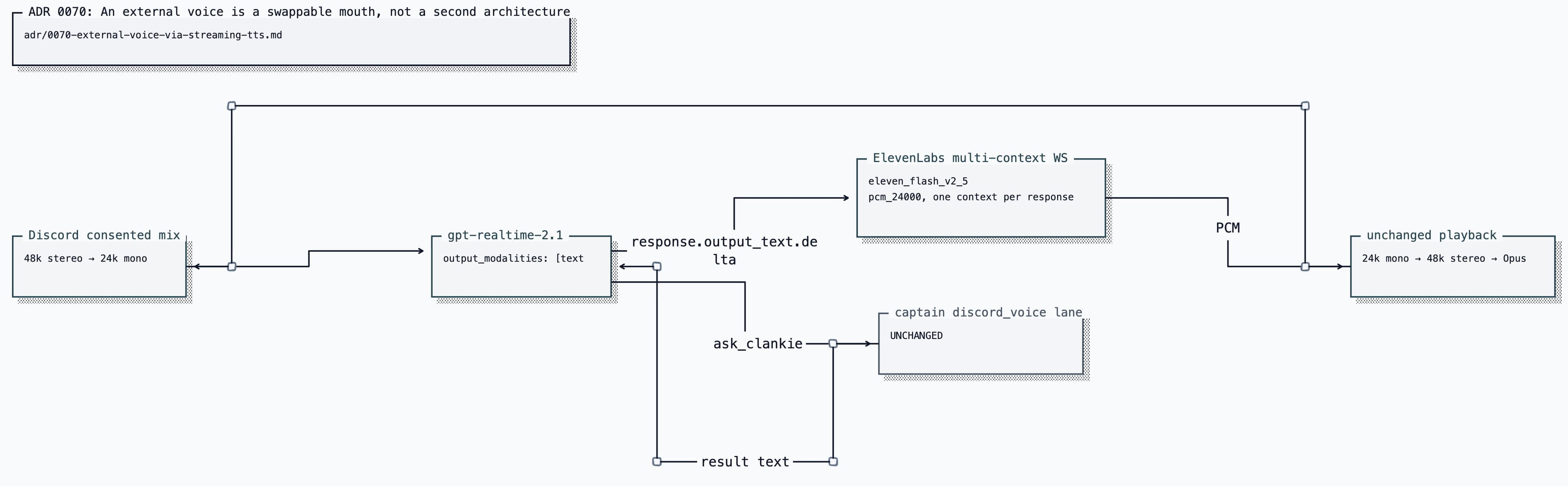
Configuration is owner-authored and settings-first. Credentials stay in the broker; provider API keys in ambient environment variables fail closed. The external boundary enforces secure-or-loopback transport, bounded text and audio, session lifetime, sanitized errors, sample alignment, and PCM zeroing. The five-minute per-utterance PCM bound admits briefings and explicit read-aloud answers while still fencing runaway output.
The adapter owns three ordering problems
- Model completion precedes synthesized audio. The adapter delays the response-done signal until TTS drains, bounded by a timeout.
- Realtime audio truncation no longer applies to text items. Barge-in closes the TTS context, drops late output, and tells the conversation that the room did not hear the remainder.
- The mouth can fail independently. A failed TTS session settles the current utterance and reopens lazily for the next one; opening a conversation proves both sides can start. Any failed synthesis step discards the mouth, not just a dropped socket — a session that reports itself open after failing a frame would otherwise be reused by every later utterance, and the failure would last the whole call instead of one turn. Before settling incomplete speech, the adapter adds a conversation marker saying the room may have heard only a prefix, so the next response does not assume the whole reply was audible. Failure receipts carry the active delivery and speaker when an utterance owns the failure, so the audible prefix, model response, and synthesis failure join without timestamp inference.
Room audio never reaches the TTS provider. Only words Clankie chooses to say do, and join/consent disclosures name that residency when configured.
Text-to-speech trades the realtime model's native prosody for an owner-selected timbre. That is a character choice, not a code default.
Evidence retained from implementation
The low-latency provider mode disabled server-side buffering, which made it incorrect to forward raw token deltas as independent utterances. The adapter therefore emits complete sentence/clause units, caps unpunctuated runs, and flushes the tail at response end. Normal completion flushes and closes the TTS context, then keeps accepting its audio until the provider's final frame; closing without that drain is reserved for interruption. First-audio receipts keep measuring the whole decision-to-audible path, including the TTS hop.
Alternatives considered
- Voice-change realtime audio was rejected because it doubles synthesis and adds another audio hop.
- Rebuild the cascade around external TTS was rejected because the captain returns to the conversational critical path.
- Use a vendor's full conversational-agent platform was rejected because floor control, authority fencing, and context would move into 1:1 defaults.
- Expose a second media-owner port was rejected because every caller would need to know which mouth was selected.
Consequences
- The captain remains off the conversational critical path; external synthesis adds one measured hop.
- Barge-in stops synthesis as well as playback, avoiding late paid output nobody hears.
- A second provider credential and session lifecycle exist only when selected.
- TTS failure settles a turn rather than wedging the room floor, and is
receipted under the
speech_synthesisstage. An utterance that dies in synthesis plays no audio and so leaves no response receipt; without a failure receipt a Clankie who cannot be heard reads exactly like a Clankie with nothing to say. - Current providers, settings, credentials, readiness, and diagnostics belong in the Discord bridge operating guide.