
ADR 0056: Voice is a separate agent from the player
Status: accepted (2026-07-26). Defines a separate gameplay voice decision alongside ADR 0049. Its scope follows ADR 0074: this agent authors for the activity overlay and the journal, and is not consulted while a voice room is listening — there the realtime session is the sole author.
Current status (2026-08-19)
The player/voice split remains inside Clankie's play loop. Per ADR 0129, external harnesses have independent bodies and no access to Clankie's voice or room-input seam. The comparison to possession below records the rationale at ratification only.
Context
The single-call player returns an action, a monologue, and an optional speak.
Current benchmark evidence shows that speech remains structurally subordinate
when the same decision handles navigation:
| Attempt | Spoke |
|---|---|
| Single-call baseline | 0 of 12 |
| Prompt-only variants | 0 of 12 |
| Cold-start fix + named audience | 0 of 16 |
| Prompt discouragement absent (gate is the cap) | 1 of 16 |
| Voice as its own agent | 7 of 16 wanted, 2 spoken |
The last row is the decision's evidence: with speech as its own decision he wants to speak seven times and the rate gate holds five. The gate governs real demand instead of an empty stream.
Follow-through is 18% for the baseline and 57% for the split-agent run. One run each makes this an observation rather than a claim, but the mechanism is plausible: the player's call does not split between two jobs.
Two independent constraints also suppress speech:
- Cold start.
turnsSinceSpokeis rendered only when non-null, and it is null until he first speaks. The signal that prompts a first remark appears only after the first remark. - Double suppression. A mechanical rate gate caps how often he can speak and the prompt tells him not to speak often. The prompt is rationing against a ceiling that is already enforced.
Together they move the single-call result from 0 to 1 in sixteen turns. The remaining cause is not wording.
In a single call the model is solving a navigation problem. speak is an
optional field it can decline at no cost, and the expressive impulse the field
wants has already been spent on monologue, which is mandatory and which the
model treats as where thinking goes. Speech is structurally subordinate to the
task it shares a call with.
Decision
Split the loop into two agents with different jobs and different authority.
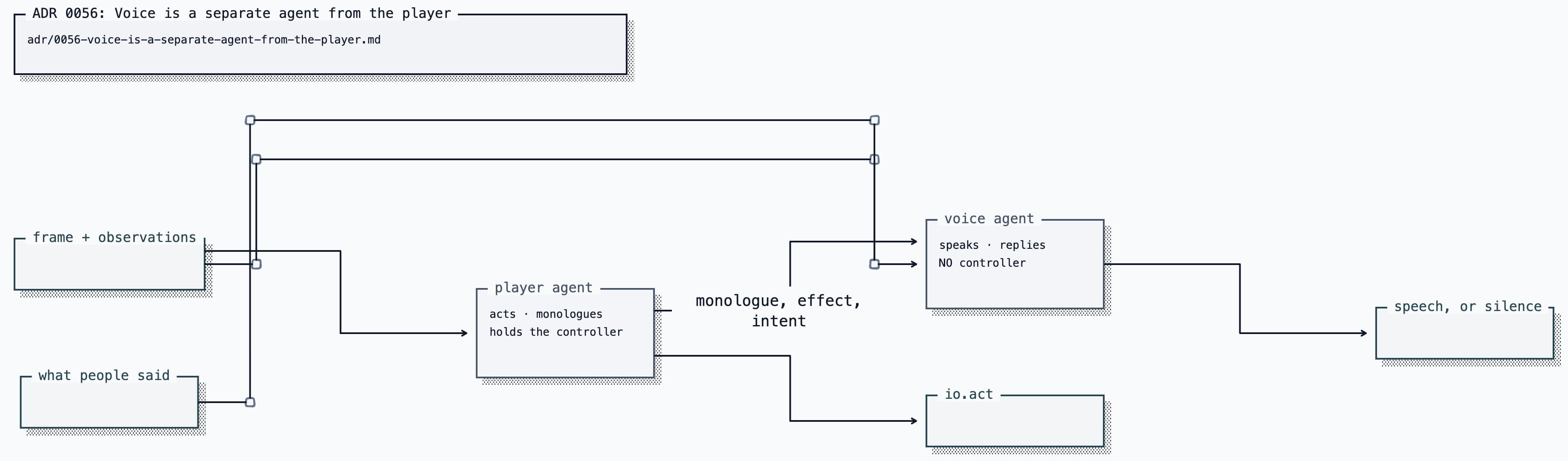
- Player decides actions and writes monologue. It has
io.act. - Voice receives the frame, the player's monologue, recent effects, and
anything people say. It decides to speak or stay silent. It has no
io.act.
Voice's speech and reply win whenever a voice is wired. The player's own
speak/reply remain on its wire schema as the single-agent fallback, so a
caller with no voice still behaves as before rather than going mute. The player
still sees an interjection, because a question about what he is doing is context
for the turn; it cannot arrive only at something that acts.
Voice's job is selection and delivery, not invention. It speaks as Clankie by choosing which of his real thoughts are worth voicing, with the monologue as its source of truth. That is what keeps it from drifting into commentary describing a screen it is only half-reading, and from becoming a sportscaster narrating every move.
Why this over more prompt work
A dedicated agent's null is not free. Deciding whether to speak is its entire
decision rather than a field it can leave empty while doing something else. The
measurements above are four independent attempts at the prompt-level fix, two of
which correct genuine defects; the ceiling stays fixed.
Why this is also a safety improvement
Without this split, the rule that an interjection must not become a route rests only on prompt wording — "someone talking to you is a person talking, not an order." Wording is not a boundary. Routing conversation to an agent that has no controller makes it structural: a message that reaches only Voice cannot steer the character, because Voice cannot act. The observed good behaviour (asked to abandon the stairs for the computer, he declined and kept his intent) stops depending on him choosing to decline.
This is the same shape as possession (ADR 0053): who talks and who drives are different authorities, and the driving one is the one that is fenced.
Consequences
- One extra model call. Voice runs when something happened or someone spoke, not
unconditionally, so it is not one call per turn. The has-something-to-consider
check alone turned out to bind never in practice — the player's monologue is
a required field, so every valid turn has something to consider — which makes
this one call per turn after all. The loop therefore also skips the
consultation when nobody spoke and the rate gate could not let an aside
through anyway: an aside the gate would drop is not worth a model call. The
skip is mechanical and content-free (rate and audience, never topic), and it
is counted in the volition metrics as
skippedso its binding stays measurable. - Voice is consulted after the action settles, so "what just happened" is the turn's real effect line. Consulting it before dispatch supplies a blank effect.
FreePlayTurn.speakand.replykeep their meaning and their bounds; only their source changes. The rate gate stays, because Voice with no ceiling is the opposite failure and the more likely one.- Both agents share the persona layer, so this is one character with two jobs rather than two characters.
VoiceDecisionSchemauses.nullable(), never.nullish(). An optional key is dropped from the JSON Schemarequiredarray and OpenAI structured output rejects the request outright. Silence is null, not absence.- Speech and monologue remain untrusted bounded model text and reach people only through the overlay and presence contracts.
- If Voice drifts into narration, the fix is its input (less frame, more monologue), not a content rule about what deserves a remark. Nothing here decides what is worth saying.
- The volition rate stays reported beside the progress metrics, so this decision is falsifiable by the same measurement that produced it.