ADR 0054: Presence is shared, world-facts stay fenced
Status: accepted (James, 2026-07-25). Amended by ADR 0084, which lets the operator seat read activity across rooms. The doctrine-governed world-fact store used as the comparison in this record was later removed; references to it below are historical, not current implementation claims.
Current status (2026-08-19)
Presence and self-authored memory remain shared across Clankie's own rooms. ADR 0129 removes possession state from the current projection: an external harness is not one of Clankie's rooms or bodies.
Context
One Clankie can have separate operator, Discord, voice, and gameplay sessions without sharing their continuation tokens or transcripts. He still needs to know where he is and retain bounded notes about what he did.
At ratification the tempting implementation was to widen a doctrine-governed world-fact store across lanes. That would also have allowed untrusted public claims to become private durable belief. The decision instead separated presence and self-authored episodes from assertions about the world.
Decision
Presence is shared; room content is not
captainSelfState projects a bounded list of Clankie's open rooms and active
bodies into each turn: lane, target, label when known, liveness, and recent
activity. It may combine operator conversations, captain lanes, live play,
Discord presence, and possession state. Continuation tokens and other rooms'
transcripts are structurally absent from that projection.
Episodes are self-authored and lane-scoped
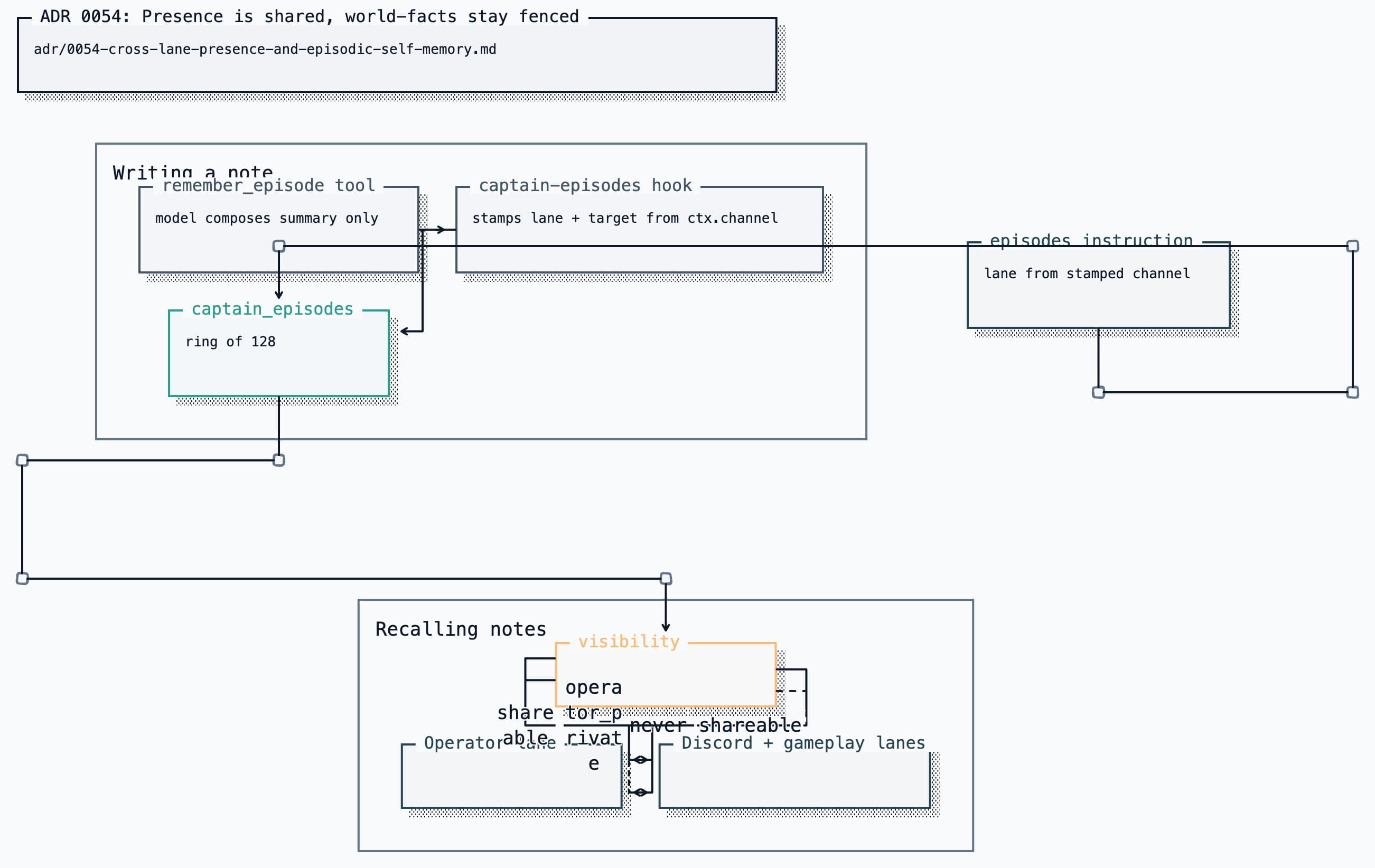
Clankie may keep a bounded episode describing what he did. The host stamps its origin lane and target; model input cannot aim a write or recall at another room. Operator-private episodes remain operator-only, while ambient recall sees only entries visible to its destination.
Editable Turbopuffer tldraw source
Recall is injected by the host rather than exposed as a destination-selecting tool. The write tool accepts bounded content and visibility, while the host stamps lane and target from authenticated turn context.
The operator may inspect, edit, and forget episodes, but cannot rewrite origin provenance or move an episode to another room. Ambient routes cannot enumerate the catalog.
Historical world-fact comparison
The retired implementation distinguished approved world facts from self-authored episodes. World facts used approval envelopes and propagation flags; episodes asserted only what Clankie did and used bounded provenance and visibility. Although that world-fact machinery no longer exists, the durable decision remains useful: a self-authored episode is not an authority-bearing claim about the world, and untrusted room text is not silently promoted into private memory.
Alternatives considered
- Share transcripts across lanes was rejected because it would persist and expose untrusted room content in a privileged conversation.
- Automatically summarize every turn was rejected because it creates notes nobody chose to keep and spends an extra model call.
- Presence without memory was rejected because whereabouts alone does not provide bounded continuity across sessions.
Consequences
- Clankie can report where he is without receiving another lane's transcript or continuation token.
- A room can influence a self-authored episode because its text was in context, but the entry stays bounded, provenance-labelled, and non-authoritative.
- The operator has one curation surface; ambient lanes receive only filtered recall cards.
- Current storage paths and memory behavior belong in the architecture guide; this record preserves the privacy and authorship boundaries.